Showing posts with label cerebral palsy. Show all posts

Saturday, February 09, 2008

Where is the outrage?

The hate crimes against people with disabilities continue. Last month, two teens and 1 young adult were sentenced in the U.K. for the brutal murder for sport of Brent Martin.

Today, it is reported in a Cleveland newspaper that 3 12-year old students, 2 boys and 1 girl, beat their 12 year classmate, who has cerebral palsy.


“A 12-year-old boy who has battled cerebral palsy and seizures his entire life couldn't fight back last week when three students attacked him after a tutoring session.
The sixth-grader felt pain in his groin after the attack and had to have a testicle removed the next day, his mother said.
East Cleveland police are investigating the attack, which happened Jan. 31 at Prospect Elementary School.
Detectives are waiting for a doctor to determine whether the beating
caused the injury, Commander Dan Heglaw said.
Three sixth-graders - two boys and a girl - kicked the 12-year-old in the back and smacked him in the head about 5 p.m., an hour after school security left the building, police said.”

This was not the first time this child was hurt by students.


“The boy is often targeted by other students because of his medical condition, a neurological disorder that impairs people's ability to control their movement and posture. He was struck by another student in November, his mother said. The school implemented a "no-bullying policy" after that attack, she said.”

This beating occurred on school property after a tutoring session. This student has been targeted more than once by his classmates. The paper reports Superintendent Myrna Corley’s response to this latest beating,


“It's an unfortunate situation.”
UNFORTUNATE?!! Better words might be: Outrageous! Will not be tolerated in my school! A hate crime that will be fully prosecuted!

The 3 students have been suspended, but that is not enough.

Where oh where, do 12 year old kids learn that violence and abuse of those that are different than them is acceptable? I just don’t believe that children are born hating. Our society is teaching the dehumanization of people with disabilities. It happens all the time in many, many forms – from our language, to our lack of inclusion, to the lack of coverage and outrage about this physical violence. Violence against with disabilities is a hate crime.

And, I think this boy deserves a fully paid transfer to another school where he will be safe and where he can do what he is supposed to be doing at school - learn.

UPDATE:
Related posts -
Disability Rights: Why it is YOUR problem
Dave
And more violence...
Respect and Disability Advocacy

Tuesday, February 05, 2008

For parents: my cerebral palsy

I have decided to share a little about my cerebral palsy because I see that parents of young children with CP have so many questions. I had been reluctant to share too much personal information, because I don't want it to detract from what's really important - namely, that people are people, disability is part of human diversity, and that I think loving your child is the most important thing you can do as a parent. Working to reduce the societal barriers to inclusion and respect comes second. I know that the parents whose blogs I check out now and then get that. So, this is for you parents. I hope it helps in some way.

To start - my childhood was a happy one. The fact that kids with disabilities have happy childhoods should not be a surprise, but to some it may be. Here's a study confirming that point.

I have spastic and athetoid quadriplegic cerebral palsy. Over the years, I have met many other people with CP, and one thing is for sure - cerebral palsy is different in each one of us. I have high tone and spasms in my legs and arms, and low tone in my trunk and neck, and athetosis in my arms and hands.

With CP, life is full of complicated decisions. I've learned that every decision has a positive and negative. Every choice has a positive consequence and a negative consequence. Sometimes the consequences are short term, sometimes they are long term. And, often, when making a choice, you just don't know what the consequences will turn out to be. As I now weigh decisions on my class schedule, exercises, rest, and fun activities that challenge me physically, I understand more how difficult it was for my parents to make decisions for me when I was younger.

Therapies:
As a child I had physical therapy, occupational therapy, and speech therapy. Mainly, I have had a lot of physical therapy. My physical therapists worked out of Children's Memorial Hospital (and are now at La Rabida Hospital). Their philosophy entails an emphasis on prone work to strengthen core and trunk muscles. I still do physical therapy, and I am still making progress. Yes, you heard that right - at 22 years of age, I am continuing to make progress. While I have worked many hours with professionals, my parents were the key people. A great deal of work was done outside of “therapy time” – work with my parents and also on my own. When I was younger, my parents had exercises and stretches that they did with me as part of a routine - like each time they changed my diaper they would stretch my hips and hamstrings. The biggest part of my work was spending huge amounts of time prone (lying on my stomach). "Prone lifts" - reaching for toys, playing with blocks, pointing to pictures in books, lying prone in my stroller were just a normal part of my day. When I was younger, I spent a great deal of time on my stomach, and had sitting time and standing time as much smaller parts of the day. I played prone with my cars and trucks and played prone in the swimming pool; it was just part of my life. For a time, I even went to school prone. When I played while lying prone, I didn't prone in the strollerknow I was strengthening my back and trunk muscles and gaining head control. At my house, it's just how we did things. I never had walkers or gait trainers because my therapists felt that I would use my tone to operate those things and that would limit my abilities more than help them. My parents carried me around a lot, brought things over to me, and I explored the world on my stomach. I did have a stander when I was younger.

Today, I’m most comfortable lying on the carpet where I can roll from my back to my stomach and change position on my own. And now, I take time throughout my day to do prone lifts on my own. While I do not like doing the lifts, I notice that when I take time off from them, my trunk and gluteal muscles get much weaker, and I have more trouble sitting and standing and also more pain in my back and legs. When I return to doing the lifts, my muscles get stronger again.

I wish I didn’t have to do so much bodywork – I think my parents and therapists were smart to mesh as much of it as possible into our daily life. But, I really got sick of the formal therapy work. I hated (and still don't like) the time it takes in my life, but the benefits of working on my body are so great. I used to think that I was going to walk - therapists and doctors told me that it was possible. But, it didn't happen. I've realized though that the primary benefit of taking care of my body is not about walking. Walking isn't that important. The real benefits are in helping my body do the best it can for me. With a stronger body and less pain, I can travel (like family vacations here and here and my trip with MIUSA to Costa Rica); go to college; sing; blog; and just do more and have more fun. Without the work, my hips and back would be pulled out of alignment by my spasticity, and that hurts. In the long run, doing therapy takes less time and is less hassle than the alternatives of pain, decreased function, and multiple surgeries. Because of my work, I have good head control and I can sit in my wheelchair for several hours at a time. Those two things are really important to my functioning. Also, because of my work, I can do a standing transfer with the assistance of one (knowledgeable) assistant. This is really important, because without a standing transfer, I would have to be lifted from one place to another - say on and off the toilet. My mother is no longer able to lift me, and without a mechanical lift, my options to go places would be very limited without a standing transfer. Now, my mother (or someone else who is trained) can help me transfer. While I'd rather be totally independent, this assisted transfer is extremely helpful to my daily life. I know that without all my work, I would not be able to do that.

AFOs/Casts/ splints
AFO’s – I have had AFO’s all my life. If made properly (and that usually takes quite a few annoying, time consuming adjustments), I don’t find them uncomfortable. I think it was harder when I was growing than it is now. I do find that the AFO’s get very cold, so I like to have a warmer pad inside the AFO on cold days. (Cold feet increase my spasms.)

For most of my life, I slept in a night body cast for several hours each night. This kept my trunk straight, my hips intact, and my legs abducted (apart). As a young child, I didn’t mind it; as an older child and teen, I hated it because it was very uncomfortable to sleep in that position since my spasticity was so great while I was growing. I could have tolerated it when awake, but sleeping was another story. But, it met the important physical goals that it was designed for; my scoliosis is minimal and my hip sockets are well formed. I have mixed feelings about using the cast.

Splints – I do have a splint that keeps my legs separated that I sometimes use during the day now. I don’t mind using that splint, and I feel the benefit of not having my legs cross.

Botox:
I had botox on my hamstrings, and for me, it didn’t help at all.

Serial casting:
I had serial casting twice. The first time was when I was about 8, and it was successful in lengthening my Achilles Tendon. The casts didn’t hurt; it was just annoying to wear them and to have weekly appointments for months on end.
The second time I had serial casting, I was 16 years old and I had been having pain in my feet with standing. This time the casts helped a bit, but they hurt a lot. My bones had shifted over the years, and casting could only address the muscle and tendon issues. After the casting, I had bone surgery on both feet.

Surgeries:
My experience with surgery (my own and my friends) is that it’s ALWAYS harder than what the surgeon says. Based on my personal experience and that of my friends and acquaintances, I would work and do work very hard to avoid a bone surgery.

I had muscle lengthening surgery when I was 6 years old on my adductor muscles. (These muscles were tight from all the tone pulling my legs into crossing.) Physically, this surgery wasn’t that tough, but I did an intensive physical therapy program afterwards to help me retrain how I used my legs. It all felt time consuming to me, but I know it was very helpful. I made a great deal of progress being able to stand without crossing my legs.

I had my second surgery when I was 16 years old. As I said, my feet were hurting and it was getting hard to put weight on them. This was a major event – rearranging the bones of my feet. It was extremely difficult with long-term pain and an increase in horrible back and leg spasms. I would say it was about a year before the painful spasms of my legs and back reduced back to the pre-surgery level. I went to a pain management clinic for help with the pain, and that was helpful.

Now, I see a major, major benefit of bodywork as avoiding bone surgery – it is so painful, affects the whole body, and takes so much time out of your life. It's mentally very exhausting. (I recall some school aged kids with CP having a major surgery every summer. Yuk!) I would do a lot of bodywork to avoid bone surgery! I've also learned that surgery only straightens out the bone, it doesn't change the CP. So, after the surgery, the CP is still causing the problem that led you to the surgery in the first place.

Also, I wore an eye patch for several months and had 2 surgeries for strabismus (eye muscles).

Respiratory
I had lots of respiratory infections as a baby and young child. They were very debilitating. This changed after about age 7 – I worked with Mary Massery on respiratory exercises. She taught me to take a deep breath, hold it, and then cough. My parents also learned some respiratory physical therapy techniques that were helpful in preventing a cold from turning into a full blown respiratory illness. I also started singing in a choir about that time. My respiratory problems dramatically decreased as my diaphragm got stronger. Now, I still sing, and I know that that is really helpful to my body. Plus, unlike other bodywork, it's fun!

GI
CP affects my GI tract big time. I’ve had trouble with weight gain, severe reflux and vomiting, and constipation. There have been no “magic pills” to solve these problems, but with some effort they are managed to the point of being livable. The severe reflux is one problem I’d really like to get rid of.

Stamina issues
I tire very easily, both mentally and physically. Sitting well, standing well take a lot of cognitive work. My low stamina is a big frustration for me. I need a lot of rest each day. If I don't get it, I really pay the price with increased pain and tightness.

Tone/Spasticity
For me, the high tone itself is somewhat painful. It's more limiting than painful, because I can't move so well and I don't feel like I have good control over my body when it's tight. The effect of the spasticity on my hips and back can be painful - the constant pull (to cross my legs) on my hip can be painful in my hip. I've found heat to be very helpful in reducing both the spasticity and the discomfort. I like to keep my legs warm. I use little heating inserts in my AFOs, and when I am lying prone, I often have a heating pad across my butt or legs. A warm bath also relaxes the tightness. Being cold and shivering increases the tightness. Positioning my legs in a way that separates them while simultaneously applying heat helps. Also, actively using the spasming muscles helps to decrease the spasms; if I stand well and actively use my gluteal and leg muscles, the spasms decrease. But, that's hard - it takes a lot of cognitive work to get it right.

A problem with pain that can be overlooked is that pain, even mild pain, is distracting. It takes my attention away from focusing fully on something else. And that is sometimes a problem, more so than the actual discomfort of the pain.

Technology
Technology is so very important for kids with cerebral palsy. I cannot handwrite at all, but I can use my computer to send emails, write papers, etc. My Permobil wheelchair lets me change my position on my own - sitting, standing and lying down. Without the Permobil chair, I'd have pressure sores, a lot more pain, and much less function.

School
This is a big issue. I've written a little about my school experiences here and here. Between my sisters and me, we've tried full-time public school, part-time public school, full and part-time private school, and homeschooling. We did different things at different times. My parents came to view the school system as one tool of many in their toolbox. They learned that it wasn't always in my best interest to do things a certain way, just because things had always been done that way. I've found the low expectations and the challenges of finding capable assistants to be the biggest hurdles in the school system. Interestingly, and wonderfully, I am finding college easier to navigate than k - 12.
I think that it is extremely important to not have one's time filled with bodywork and schoolwork and no time for fun. That's part of the tricky balancing act that families have to figure out.

Pursuing strengths
I see it as so very important for kids with CP to pursue their strengths. It is very easy to focus on everything that needs improvement. But, for me, my strengths are what helped me fit in with other kids, what gave me confidence, what gave me fun, and what now may help me to be employed or have fun as an adult. I am so glad that my parents helped me to have singing lessons and choir experiences. I am glad I didn't focus on handwriting in elementary school. It was a good decision to take higher level Spanish classes in highschool and skip some math classes; my strengths are auditory and my learning disability is visual.

Parents/Making decisions
There are things I wish my parents had done differently. For example, I wish I had homeschooled more in elementary school. I think it would have been less stressful to me, and more efficient for my time. I think school took up too much of my time, particularly when the way things were done didn't match my learning needs and simply wasted my energy. I wish my parents had intervened sooner with one of my problem school aides. And, I wonder how life would have been with less therapy time. There were plenty of times that I hated going to therapy.

I am very grateful that my parents were able to go against the culture or the "way things were always done". I am so glad they were strong advocates for me. They tell me that they learned that over time. They didn't start out that way.

I also now appreciate how very difficult decisions for me really were. As I have taken over more and more responsibility for these decisions, I realize that there are not easy answers. My parents did the best they could. And, I have learned from them to not dwell on the mistakes or the things I wish I had done differently, but to keep learning and move on. I think if my parents were wracked with guilt and fear about making mistakes, I'd pick up that attitude also. And that attitude could paralyze future decision making.

This post was a joint effort with my mom. I hope it is helpful to parents. Again, these are my personal experiences; everybody is different. Let me know if you have any other questions.

So, my summary points - love your child, promote strengths, do the best you can with the complicated decisions, think "outside the box", and don't be too hard on yourself.

It's very important that we all work to change society so that those of us with cerebral palsy can be full members. Support the ADA Restoration Act, model inclusive attitudes and advocate for a better world.

UPDATE: My parents and I continue to think of many other things that could be helpful to a family with a young child. Here are a couple more.
-During the years when I rebelled against formal therapy, (in addition to meshing the work into my day like I described above), my parents tried to make therapy fun. I had books read to me or played guessing games or various things to help me "enjoy" the time more. It didn't really work, but it did help. Also, when I was about 4 years old, something that worked was a "reward" for "working hard" in therapy. I got to do an art project that was only done after a session during which I cooperated (so the reward was not based on "what" I did, but just that I gave a reasonable effort). My mom had a stash of paper plates that I decorated with glitter, paint, felt, whatever, and then she put them on display on the wall. Whenever someone came over, they would ask (with some prompting by my parents) about all the art on the wall. I would feel proud of my accomplishments. My parents never wanted to punish me for not cooperating with something that was inherently unpleasant, so they just used rewards or lack of rewards. And, I did get a time out if I would bite the therapist or do something really nasty. ; ) No art project on those days!
But, I do think the best way to work on my body was just having it be part of my day.
-Also, my parents came to learn that no "expert", in health care or education, was more expert than they were. They used "experts" like consultants, weighing what they would say against their own experience with me and against their gut feel. (And, by the way, they didn't get the hang of this until after they were misled a few times.) They also learned to be very creative as they weighed different choices, starting with what their goals were for me and then deciding how to use others' advice.

Wednesday, January 30, 2008

Questions about cerebral palsy

I have been working on a post about my cerebral palsy. I haven't written so much about that topic because I had originally intended my blog to be about my interviews with people with disabilities and the societal issues of disability.

But, after reading Kathryn's recent post, and Billie's blog and Jacqui's blog and others, I think that maybe some information about how CP is for me could be helpful.

So, parents of young children with cerebral palsy, do you have a question you'd like me (or maybe my mom) to address about my CP now or when I was younger? If so, leave a comment here.

Monday, December 31, 2007

Year in Review: Reflections on the Ashley Treatment and Other Memorable Posts

When I planned to take a year to interview people about growing up with a disability, the blogging was an afterthought. It was a way to share the interviews and some of my thoughts. 2007 didn't quite go as I expected, project-wise and blog-wise, and there was so much learning that I didn't anticipate.

In January of 2007, I heard about the "Ashley Treatment" - the so-called treatment being a hysterectomy, breast removal, and high-dose hormones to suppress the growth of a 6 year old girl with cerebral palsy. I didn't think I was naive - I have a loving home, but knew very well that many in the world don't. I've had my own negative experiences with societal institutions - healthcare and education, in particular. I have experienced ableism - discrimination based on ability. I had read about the civil rights movement, listened to black friends talk about racism, listened to women talk about sexism. But, blogging about the Ashley Treatment was a turning point for me. I just did not realize that so many, many people could think that what happened to that little girl was ok. Some people I care about thought it was OK. Some people I didn't even know thought they could say cruel and hateful things to me, because I spoke for this child's rights.

So, I guess I was naive.

A flood of emotions and thoughts come out of that experience. What is it with this world that we cannot recognize humanity in each other?

I realize how little the able-bodied community understands about living with a disability. They see us as less than they are, often as disposable, and they feel sorry for our caregivers. Our cultural institutions don't support us, and the media misrepresents us or worse.

Now I see many more injustices in the world. And I'm sure that there are many more that I don't see. So many people in the world are seen as "less than", as disposable.

And sometimes I see injustice where there is none. This reminds me of an episode of the TV show House, where Dr. House, who has a leg impairment, sees Christmas candy canes, and says, "Candy Canes! Are you mocking me?" Except in real life it's not so funny.

It's hard not to feel cynical, frustrated, and hopeless. (Check out Cripchick's recent posting on society's reactions to another young child with cerebral palsy. It's tempting to withdraw and pull myself out of all of this stress. Why put myself through the hardship of living in a broken society, a society where many members are not accepted for who they are?

But, I won't withdraw. I am not going to let others define me. This is my world, too. And, I want change. Actually, I want change now, and I feel impatient. (Some days I really don't want to be spending my time in school. My stamina is limited, my health needs take time, and I feel a restlessness spending my productive energy on schoolwork. I'd like to have time to pay more attention to what's happening outside of my life and outside of the classroom. I'd like to get back to interviewing.)

I have, as well, developed a renewed sense of appreciation for activists of all stripes both now and throughout history.

So blogging about the Ashley Treatment changed me.

A few other posts from 2007 that have a strong meaning for me:

1. A Day at Work. In this post I share the typical work day of Chris, a mail clerk at Rotary International. I am very proud of this post. It’s about a man who works hard and loves his job, and the fact that he has a disability is irrelevant. Every workplace should have workers like Chris. If the media, educational facilities, health care institutions, airlines, and the government had workers as conscientious and dedicated as Chris, my life and the lives of others would be impacted immeasurably.

2. Sandbox Lessons. This is the post I wrote for Blogging Against Disablism Day 2007, a post that shares a story from my childhood about how children become ableist.

3. My Costa Rica Experience: A Slideshow and Reflections. My trip to Costa Rica was an amazing experience and I am so grateful to Mobility International USA; Ryan my personal assistant; Eduardo, Marianela, and Maripaz, my host family; and my family and friends who supported me for this wonderful opportunity to learn a little about life in Costa Rica and to learn a lot about me.
4. Understanding the Less Common Perspective. So many people have difficulty understanding my perspective and life experiences living with a disability. This post shared an essay I wrote about my educational experiences for my English class.

My next semester starts in a couple of weeks. Taking 2 classes at a time fills my time. I hope to blog when I can.

I wish you and yours a safe and blessed New Year. All the best in 2008!

Tuesday, October 09, 2007

Another assault on human rights

How can it not break your heart to hear of people being treated as less than human? I know it can be seen over and over again around the world, but it still feels like a punch in the stomach, knocking me breathless and sapping my energy.

Last January, I was shocked to learn of the decision and public support for the surgical and hormonal alteration of a 6 year old girl. Now it's happening again, this time in the UK, and this time I feel older and I am not surprised; I just feel great sadness. Why is it that our societies don't or won't support families challenged by the care of their loved ones with disabilities? How do we convince ourselves that we don't need to think creatively, that we don't need to problem-solve, that we can jump right in and tinker with the healthy body parts of another person?

I hope I never am convinced. I'd rather feel a punch in the stomach than cold, mind-numbing apathy.

Helpful links:

Penny Richards at Disability Studies at Temple U is continually updating links to bloggers' views on this issue.
When the Slippery Slope Becomes a Mudslide - Exceptional Parent's position statement
United Nations Convention on the Rights of Persons with Disabilities
Modify the System, Not the Person from the Disability Rights Education Rights & Education Defense Fund

Tuesday, August 14, 2007

Kids Are Kids!

Thanks to Ruth and Connie for finding this interesting article about a recent study that concludes children with cerebral palsy are no less happy then their able bodied peers,

The study surveyed 500 8-12 year old children with cerebral palsy and found that while they participated in less activities then able bodied children their enjoyment of life was just as great.

Professor Alan Colver, of Newcastle University who conducted the study hit the nail on the head.” The change now needed concerns attitudes. Pity and sorrow should not be directed to disabled children because our findings indicate that they experience life as do non-disabled children. Maximum effort is needed to ensure their rights as citizens, rather than as disabled children, to participate in society as fully as other children."

Of course! Kids are kids. They just want to have a good time. Check out pictures of Moo, Ellie, Holland and Eden all having fun.

Let’s do what we can to not take happiness away from children through exclusion, pity, and lack of opportunity.

Monday, August 06, 2007

I Like Vacations!


I just returned from a beautiful trip to Wisconsin where I went bike riding on the Rails to Trails Elroy-Sparta bike trail, swam, played card games with my family, and went to a play.

I really look forward to going on a vacation. One reason is because it’s a welcome break from the everyday hassles of appointments, therapy, equipment, caregivers, etc, etc. Sometimes the everyday "stuff" of living with cerebral palsy can drive me crazy. It’s nice to get away, relax, explore new places, and hangout with my family. Of course, there are plenty of hassles with traveling, but I try not to dwell on them and try to enjoy the new adventures.


My parents bought this Duet bike 11 years ago. I love riding on it because I can feel the wind in my face and being on trails feels calm and peaceful. I cannot last too long on it because it doesn’t provide enough support. But that’s okay – it’s fun!


The Elroy-Sparta Bike Trail is neat
because it is fairly level (having been an old train track) and scenic. It also has many bridges that you cross and 3 long, dark, creepy tunnels that you walk your bike through.


The picture of me on the bench is when I was taking a lunch break at Gina’s Pies are Square. Yum!


I like to swim. We’ve figured out a way that works well for me. I wear a life jacket (it gives head support) and an inexpensive inner tube. When I’m not relaxing and floating on my back (like in this picture from a few years ago), I can paddle on my stomach and swim around. Moving in the water is so much easier for me than moving with gravity.


This card holder has seen me through many games of GO FISH, Old Maid, rummy, hearts, and poker. This trip we played Back Alley Bridge and Euchre.


Recently, my family has started taking in a play on some vacations. This time we went to the American Player’s Theatre in Spring Green, Wisconsin. It was fabulous!

I like vacations! Can't wait for the next one!

Friday, May 25, 2007

Disability Stories and The Media

Yesterday, I heard on the radio two short pieces about young adults with disabilities.

The first, "Student with Cerebral Palsy to Graduate,” was on NPR's Morning Edition. A guest professor who had taught a class at the University of Delaware shared his experience of meeting a student and his mother.

After listening to this story, I felt compelled to write to NPR. I wrote,

“I am 21 years old and, like Sumner Spence, have cerebral palsy. I am so tired of the media’s portrayal of persons with disabilities and their families as either pitiful or inspirational. Both pity and inspiration are two sides of the same coin – the stereotype that people with disabilities are inferior beings; so either feel sorry for us or be inspired when we don’t match imposed boundaries and labels.

Why should a university professor be surprised that a university student would offer “sharp observations” and ask “smart questions?” Because of a wheelchair or weak hands? Not only do students with disabilities have experiences common to all students, we also have a wealth of perspectives shaped by living with our disabilities – perspectives that those who are able-bodied cannot possibly have, perspectives that can add to the diversity of intellectual discussions.”

This story was by no means as bad as those "feel good" sports stories where the kid with a disability is allowed to score a touchdown or make a basket. But I wrote the letter because people with disabilities cannot be respected as full members of humanity until society drops the inspiration/pity stereotype.

Last night, I heard the piece, "The Dog That Changed Her Owner's Life," on BBC Outlook. Hannah Baker, a 21-year-old woman who at one time could barely leave her house because of a seizure disorder, told how her life was changed by a service dog. I really liked how this interview was conducted, because Hannah shared her life experiences in her own words and the interviewer asked deep, thoughtful questions, seeking to understand the whole picture. Most importantly, there were no underlying messages of inferiority or pity or inspiration given to the listener. It was a fascinating story and the young woman’s disability was one part of it.

Monday, April 30, 2007

Sandbox Lessons

Blogging Against Disablism Day, May 1st 2007

I was listening to the song, “You’ve Got to be Carefully Taught” from the musical South Pacific. The song asserts that children are not born racist, they must learn to be racist. I think that same truth applies to ableism. Children are not born believing that some differences make a person inferior; they have to be taught. It's easy to see how Jerry Lewis’s Muscular Dystrophy Telethon, inaccessible buildings, overt discrimination, or the common use of words such as "retard" or "cripple" teach ableism. It is more challenging to realize that even well-intentioned people, themselves products of the culture we live in, can inadvertently foster the ableist paradigm in children.

My mom remembers a telling story that took place on an ordinary day many years ago. My two sisters and I were about 4 years old at the time (we’re triplets) and were playing in our backyard sandbox. It was a warm, sunny summer afternoon. My sisters were running back and forth between the sandbox and the hose to get water for our sandcastles. I was lying on my stomach, as I often did, playing in the sand with my hands, my shovel, and my truck. We were laughing and having fun.

Unbeknownst to my sisters and me, a six year old boy who was visiting our next door neighbors was intently watching us through the chain link fence.

At some point, one of my sisters went near the fence, and the boy asked her, “Does he walk?”

My mom says she held her breath, ready to jump into the conversation and stand up for me. Ever the advocate, she would've said something sappy like, “He can’t walk, but he's really good at playing in the sand.”

Had my protective grandparents been around, one of them might have scolded the boy, “Hey! That’s a rude question!”

An educator or social worker, seeing a potential peer socialization experience for me, might have answered with a heavy, deliberate sigh, “No… he's not able to walk.” Then with forced enthusiasm, “Why don't you go play with him? It doesn't have to be very long, just a few minutes. You'll feel good helping the boy."

A healthcare provider, intending to minimize the importance of physical differences, might have lectured the boy on my condition of cerebral palsy, "The motor area of his brain was damaged because he was born too early. This damage causes him not to have good control of his arms and legs. Even though his body is different from our bodies, he's really just like us.”

The boy's dad, not wanting his son to be offensive or rude, might have pulled his son away from the fence, “Shhh…. Don't stare! Don't make him feel bad."

On the surface, these responses to the boy's question may seem appropriate. But imagine, if you will, the boy at the fence asking my sister a different question. Suppose he asked, "does he have red hair?"

"No, he doesn't, but he's really good at playing in the sand."

"Hey! That's a rude question!"

Heavy sigh, “No… he doesn't have red hair.” Forced enthusiasm, “Why don't you go play with him? It doesn't have to be very long, just a few minutes. You'll feel good helping the boy."

"He’s genetically heterozygous for the brown haired trait. Even though his body is different from our bodies, he's really just like us.”

“Shhh…. Don't stare! Don't make him feel bad."


So, how did the four year old's and six year old’s interaction play out that sunny summer day?

Not assuming any hidden meaning to the boy’s “Does he walk?", my sister simply said, "no."

The boy accepted her simple answer to his simple question. Then he moved on to his more important question, "Can I play? We could use my yellow dump truck to move the sand.”

The boy, and soon the neighbor kids, came over. The sand castles got bigger, the laughter louder. We all had a great time.


Be sure to check out the many other posts for Blogging Against Disablism Day. Thanks, Goldfish for organizing this event.

Monday, April 09, 2007

The Juggling Act

With my cerebral palsy, I have to be very conscious of setting priorities for my time and energy. I must plan my time very carefully because I have very limited stamina and activity causes painful spasms in my neck, shoulders, back, and legs. Last week, I sang with my choir for the Holy Week services. It was a wonderful, exhilarating experience that took all my physical energy. My blog got pushed down my priority list.

Also last week, I got called for an interview by Mobility International USA. I'll find out if I get accepted for the Costa Rica Disability Exchange Program on April 20. I'm keeping my fingers crossed, I hope I get accepted.

Description of picture: Five colored juggling balls in the air.

Sunday, March 04, 2007

College Challenges

“Christine” is a fun-loving, self-motivated sophomore at a major state university located a few hours from her home. She candidly shared her transition-to-college experiences. In her senior year of high school, Christine searched for a college that had wheelchair accessible academic facilities and dormitories as well as strong, reliable support services.

For all students, heading off to college for the first time presents new challenges. For Christine, one of those challenges was hiring, meeting, and adjusting to caregivers other than her parents. Several weeks before school started, her university's Office of Disability Support Services gave Christine a list of townspeople interested in employment as a personal assistant. Christine interviewed applicants over the telephone, and, sight unseen, hired those she thought best qualified. On the first day of school, after her parents helped her get settled in her dorm room, one of her newly hired personal assistants helped Christine with her nighttime needs.

Christine needs a personal assistant twice a day, in the morning to help her get out of bed and ready for the day and in the evening to help her get ready for bed. Throughout the day, Christine receives meal setup help from food service personnel, and help from friends with any tasks that she is unable to do independently. With the help of her professors, she hires classmates to take notes for her.

One who is inexperienced with service providers might think that once Christine hired a few personal assistants from the school's list, she was set for the school year. Nothing could be further from the truth. Dealing with all aspects of caregiver issues is a constant challenge. Christine says it's the biggest challenge of college life. Her personal assistants have not always been reliable; Christine was stuck in bed one morning when one assistant failed to show! A few of her assistants have been incompetent; some have treated her rudely or condescendingly. Christine has fired assistants. In addition, she has had to deal with a high turnover rate, teaching each new assistant how to meet her needs.

Now that Christine is in the middle of her second year at college, she has found that she prefers finding her personal assistants from among her fellow college students rather than from the Office of Disability Support Services’ list of townspeople. She feels more capable of judging in advance whether the college students will work out work out because she knows them personally. Christine has been more successful at finding respectful, competent assistants from among her peers. To deal with turnover issues, Christine always a few backup assistants ready so that she can assured of being functional each and every day.

Some of Christine's personal assistants have been her friends. This situation requires some special attention. On the one hand, Christine likes having a friend as a personal assistant, because she has a trustworthy, respectful caregiver who knows her needs. On the other hand, Christine recognizes that there is a potential for a strain on the friendship. Christine openly discusses this risk with her friend, emphasizing that the friendship is more important than the assistant position.

Christine's transition to college has been successful. She loves being able to live independently and is enjoying college life. She has developed wonderful friendships. An observation that Christine made is that college students are better able than high school students to look past superficial differences to form genuine friendships.

Christine's long-term plans include a graduate degree in social work, with the goal of working in disability advocacy.

Saturday, February 10, 2007

Again: Those evil pronouns and other stories

Last weekend I was ambitious, and I posted two posts. Some of you may not have seen my first post on dehumanization.

I’ve been thinking a lot about dehumanization - particularly in the context of the Ashley Treatment and the ensuing public discussion. Dehumanization comes in many forms, and those of us deemed the "less favored humans" face it often. So, I am reposting my dehumanization post.


There was a time when I was a young child that I thought pronouns were bad words. When I would go to a restaurant, the waiter, with a quick, covert glance my way, would ask, "what would …. he-e-e like?” At the zoo, we would invariably encounter a grandma who would turn her eyes away from me and demand to know, "what's wrong with … hi-i-i-m?” On the first day of kindergarten, a mom walked up to my mom and asked, “what's … hi-i-i-s diagnosis?” The setting varied, but the indignity felt the same. I’d be having a good time, and then out of the blue - the dreaded pronoun, spoken with a slow, deliberate emphasis, preceded by a pause and accompanied by a lack of eye contact. These all too frequent experiences made me feel bad, but at the time I didn't understand why. I felt painfully dehumanized and blamed the pronoun.

Dehumanization, treating people as though not human, rears its ugly head in many different ways in the lives of people with disabilities.
It can be seen…
…when we are viewed as pitiful,
…when we are called inspirational as we face the challenges that society has set up for us,
… when people treat us like cute little pets,
…when people do not speak to us but rather to our caregivers or our friends with able bodies,
…when people are overtly cruel to us because we look, talk, or think differently,
…when people assume that because we have disabilities, we don't have any gifts or talents.

In their own words, here are three individual stories of dehumanization.

Donna said,

“When I was in 7th grade, I was supposed to be wearing a brace on my right leg to support my feet as I had no ankle movement. I was picked on so badly by one girl that I refused to wear the brace. I mistakenly thought that if I didn't wear the brace, she'd stop picking on me. Was I ever wrong. I gave her much more ammunition by not wearing it. She had a few close friends whom she managed to sway into humiliating me. They did every chance they could when there wasn't an adult in earshot. I will never forget their comments - look at her skinny legs, look at how funny she walks, she can't even pick up her own feet. They'd talk about me like I wasn't even there, or like I was deaf. And if I could hear them, I'm sure they assumed I couldn't understand what they were saying. It all came to a head one day when they were passing around "slam books" where each kid had their own page. On the first page, you would sign your name on a numbered line. Then, on that same line number on each kid's page, you would write your comments about the kid. I was one of the last ones to get the book (of course, the teachers didn't know about this) and when I got to my page, out of 20 or so comments, only 1 girl said anything positive. It was one of the most humiliating moments of my life. All of the other kids were watching me read their nasty comments about me. I finally decided I was bigger than they were, so on every page, except the girl who gave me a positive comment, I wrote "no comment" on their page. I don't remember what happened after that. I just remember feeling that I never in my life wanted to feel that way again and the only way to do that was to toughen myself against other people's comments.”


“Christine” shares an example of a more subtle type of dehumanization.

“The other day, I was in the mall with my friends and this stranger comes up and gives me a hug and he was telling me, ‘everything will be all right, honey’ . Of course, he meant very well, he just didn’t understand.

David: what did you do? How did you handle it?

I just let him do it. I mean… (laugh) then he can get away from me quickly. (I) just smiled at my friends.

David: what did your friends think?


One of my friends told me that strangers talk to me like I was a baby. She said, “How can you stand it, ‘Christine’? I just told her, ‘it’s an everyday thing. It happens a lot. I just have to know how to get out.”


Darlene, a greeting card writer, says:
“I was born with mild Cerebral Palsy 55 years ago. I love life. My husband, our son and I enjoy doing almost everything … (A)fter sharing one of the poems I’d written with a lady, her reply was ‘how does a person like you write something like that’? You might ask if I was shocked by her statement; no I wasn’t, I wish I had been. What most people do not realize is appearances are misleading, so deceiving. I might look different than you, I may even stumble some when I try to continue to walk against the odds, I may even use the wrong word here and there when I start a conversation with you in the elevator. Without a second thought sir, madam, I will give you a chance to give back what so many have taken away.”


I’ve been thinking about how to help people see that we with disabilities are a part of the diversity of humanity - that we are not different inferior, different inspirational, different weird, different to be afraid of. Rather, we are different fellow humans, each of us an individual.

For the past few years, I've spent one day each March talking with classes of high school students about disabilities. I'm not sure that that's the solution, because that has me trying to undo years worth of life’s experiences in a 50 minute "lesson". The view that people with disabilities are separate from humanity is so deeply ingrained in our culture, and a lesson just addresses what’s on the surface. There’s a need to go deeper.

So, maybe, I am wondering, the thing to address is that false core belief that diversity of ability means that some are not equal members of the human race. Maybe the way to address this ignorance is through just being present more in daily life. When on my jury duty the other day, I noticed that I was the only person with cerebral palsy in the jurors’ waiting room. I wondered what the other jurors, the sheriffs, and the lawyers thought when they saw me as a potential juror. I hope that my presence impacted someone, and I wonder if this type of experience gets inside of people more than a "lesson" on disability awareness.

Sunday, February 04, 2007

Jury Duty

Last Tuesday, I had my first jury duty. I had heard that the experience was very long and tedious with a lot of waiting around. Because of my low stamina, need for help going to the bathroom, pain with prolonged sitting, inability to handwrite, and need for help with eating, I had valid reasons to get out of serving. What's more, it's always such a hassle to have to prove myself and advocate for myself in a new setting. It was very tempting excuse myself. However, I decided to give it a try because I had heard that jury duty was a good learning experience, and I thought it would be a way for me to contribute.

My mom called the courthouse a few weeks before my service date, finding out about accessible parking and the accessibility of the courthouse in general. She was also told that I would be able to have a caregiver.

I arrived with my mom, who was my caregiver for the day, at the courthouse at 9:45 a.m. The front entrance was nicely wheelchair accessible with a gently sloping ramp and a power door. I went through security. I appreciated the respect from the guard who looked me in the eye when he spoke with me. He seemed intrigued that even though I could have been excused, I still wanted to serve as a juror. He told me a little about himself and his job in the courthouse. We had a nice conversation while we waited for my mother to get through her longer security line.

I took the elevator to the third floor and checked myself into the juror waiting room. The sheriff was unfamiliar with the rules about people with disabilities and told me to check with his supervisor. When I met the supervisor, he immediately made eye contact with my mother rather than with me. He was reluctant to have me go through the jury process; he thought I should go home. My mom and I did the subtle things we usually do to encourage him to talk with me rather than with her. The supervisor told my mom that the cases involve sex offenders, kidnappers, and murderers and can “get pretty graphic”. He also stated that, at the ruling of the Chief Judge, no caregivers were allowed in the juror waiting room (contrary to what my mom had been told on the phone). The supervisor gave me every opportunity to get out of serving, but I refused. I wanted to serve. Interestingly, when I insisted that that was my decision, the supervisor’s eye contact with me improved, and we were able to have a productive, problem solving conversation. It was decided that my mom would wait outside the waiting area door and help me with bathrooming and eating during the break. If I were to be called for a case, I would work out the arrangements with the presiding judge.

There were a few hundred jurors in the waiting room. They were diverse ethnically and ranged in age from about 20 to 75. There were no other jurors in wheelchairs; one juror had a court-supplied sign language interpreter. The staff divided us into different groups, mine was number 10. No jurors were called in the morning so I just read a book, rested, and chatted a little (mostly about the Super Bowl) with the other jurors.

There was an hour and a half break for lunch. I met up with my mom and we took care of all my needs. Immediately after lunch, 5 groups were selected, but not my group number 10. About an hour later, group number 10 was called. I was excited. I thought I would be going to jury selection for a case. However, our group was informed that the defendant in our case had chosen a bench trial instead of a jury trial and that we were excused to go home.

I think I made a good choice to serve on jury duty, even though I could have gotten excused. I am hoping that my fellow jurors and the courthouse staff took advantage of the opportunity to view me as a fellow member of the jury pool.

Lately, I have been wondering if I make an impact on dismantling the ableist assumptions of society simply by doing ordinary things. When my disability is seen as part of the diversity of society, maybe that helps change attitudes. I know I have a lot of valid reasons, such as fatigue, pain, inaccessibility, hassle and more, to discourage my participation, but perhaps by doing everyday things like serving on jury duty or going to the movies or going shopping, a deeper realization of disability as part of diversity takes place.

Thursday, February 01, 2007

I'll Do It Myself


If you've ever had extensive therapy as a child, I think you will relate to this story. I sure do.


"Speech therapy seemed rather bizarre to me. The therapist sat on a floor mat, with me lying on my back between her outstretched legs. My legs wrapped around her waist and her stinky toes in close proximity to my nose. She then proceeded to stick her fingers in my mouth to wiggle my lips, supposedly to loosen them. She alternated between her fingers and ice cubes. Then, for the actual speaking exercise, she pushed on my chest in attempts to improve my breathing capacity. After all those years of this hefty woman pushing down on my chest, I am convinced that was why I was such a late bloomer.

The thing that puzzled me, as I laid there on my back staring at the ceiling tiles, was what was I suppose to do when I met people outside as I got older? Was I to lay down on my back, on the floor, before speaking to them? I envisioned myself sprawled out on the ground when meeting a friend at the shopping mall or grocery store. Definitely not a dignified thought. Perhaps not surprisingly, pillow talk is some of my clearest speech!

After the speech therapist with stinky toes, I had one for a brief time who had me sit up for the entire session. What a concept! One of the most sensible things we did was make an alphabet card, small enough to carry with me, that I could use when people didn’t understand what I was saying. I simply spelled out the word on the card. Sometimes the low-tech solution works the best. I’ve had many variations of that card through the years."


This is an excerpt from Glenda Watson Hyatt’s book, I'll Do It Myself. Glenda is from Surrey, British Columbia. She has been a vocational and career counselor and also a web accessibility designer. Glenda has wanted to write her autobiography since she was 10 years old. And she finally did it! She is now on a whirlwind virtual book tour of 40 blogs in 40 days.

I asked Glenda about her writing and her life.

1. Why did you write your book? What do you hope people will take away from it?

I wrote my autobiography I’ll Do It Myself as part of my legacy, as my way of passing on the lessons I’ve learned in hopes of making someone else’s life easier, as my way of showing that having cerebral palsy is not a death sentence, but rather a life sentence.

First, and foremost, I wrote I’ll Do It Myself for youth and young adults with cerebral palsy and other disabilities to motivate, to inspire and to share how I have navigated life. Sometimes simply reading how someone else handled a particular situation gives the reader the encouragement and ideas for handling a similar situation. Other times knowing others have had similar experiences – to know one is not alone – can be so comforting, and can offer strength and hope.

Secondly, I also wrote the book for parents, who, after having their bundle of joy gently placed in their awaiting arms, are given the devastating news their baby has cerebral palsy. In an instant, their hopes and dreams for their child, as well as for their family, are smashed. I hope this book offers a glimmer of hope for these parents, as well as for the siblings, grandparents, aunts and uncles. I want to show that life can still be meaningful, despite cerebral palsy. I hope the book offers parents insights and ideas when raising a child with cp; however, realizing that no two children with cp are the same, there is no guarantee these ideas will be appropriate for every child.


2. In his memoir, Planet of the Blind, Steve Kuusisto talks about learning to “walk upright” –accepting his disability while recognizing that he is not defined by it and living a full life. Do you have any transformational experiences that you can share?

Due to my cerebral palsy I have a significant speech impairment; I speak Glenda-ish, which few people take the time to understand. Medical experts have labeled me as “functionally non-verbal” – a label that my husband vehemently disagrees with.

A couple of years ago I was asked to give a brief speech. Because of my speech, my initial reaction was “No, I can’t.” But, being raised without the word can’t allowed in my vocabulary, that was a fleeing thought. My mind then turned to how can I do this.

Using a text-to-speech software loaded onto my laptop, I was able to give my first ever speech. It was amazing! At a later event, using my synthesized voice on my laptop and my pre-canned comments, I actually put up my hand to say something for the first time in my life!

Now, with similar text-to-mp3 technology, now I can eve
n podcast! This non-verbal red-head is podcasting! I feel like a butterfly, emerging from my cocoon of silence. I can now reach people in a new way, and who knows what opportunities will arise now that I can podcast!

I no longer consider myself non-verbal; instead, I have a significant speech impairment. This has been an empowering experience as I try on words that better describe and define me, rather than being burden with labels imposed upon me by medical professionals or strangers. It will continue to be a journey, a process, as I transition from being non-verbal to speech impaired. This will likely mean taking steps, even baby steps, as I take on this new role.


3. What advice do you have for someone like me, a young person with a disability planning his future?

David, I would say hold on to your dreams. You will, no doubt, have parents, instructors, employment counsellors, vocational rehab workers and countless others offering advice on what you should do with your life; some may even strongly encourage you to go in a particular direction. Openly listen to their advice, even explore the various options suggested. But, in the end, it is your life, your choice. Pay attention to your interests, your values, your passions, your dreams. Choose what feels right to you (with a dose of reality) and then go for it. The future is yours!


4. What’s next for you?

Since my book I’ll Do It Myself began as a dream when I was ten and has taken me thirty years to get to this point, I’m going to do all I can to promote it. Next quarter, I’m planning to do a Flash movie using childhood photos to put up on YouTube, to do some video viral marketing. First I need to learn enough Flash to be able to put my idea into action. I’m also planning to develop an e-course “Accessibility in Action”. Over the years, I have found that people have fears when interacting with those with disabilities because they simply don’t know what to do and they are too embarrassed to ask. I want to address those fears by providing practical information and a safe place to ask questions. The e-course would include topics like what language to use when referring to people with disabilities, tips for when communicating with people with disabilities, ideas for when choosing a gift for a relative/friend/colleague with a disability, suggestions for how to include a classmate with a disability at your child’s birthday party, and many other topics. My goal is to include hands-on and practical information that people can use in everyday life. Meanwhile, I will wait for the seed of my next big dream to be planted. Perhaps it will be a movie based upon I’ll Do It Myself!


You can learn more about Glenda and join her for the rest of the virtual book tour here. If you'd like, you can sign up there to receive blog updates, or to order a copy of her book.

Glenda, thank you so much for taking the time to share some of your thoughts. Best of luck on your book tour.


Thursday, January 25, 2007

My Autistic boy and other adventures in fatherhood

Last November, my blog and Jerry Grasso’s blog were both featured at the AOL Ability Site of the Day on the same day. Jerry writes about his life, in all its glory and variety, as the dad of Maya and Demetrius. Check out this hilarious post about Demetrius and Maya getting hold of the camera.

Jerry says, “hey, life is life...it is what we are trying to do with it that counts!"

Jerry asked me several weeks ago for an interview. He patiently waited for my answers to his questions and posted them today on his blog. Another interesting person in the blogging world.

Thanks, Jerry.

Friday, December 15, 2006

And they don't even have snow in Los Angeles

Four days after our first snowfall of the season, I had a dentist appointment. The dental office is about a half mile from my house. I live in an urban area with sidewalks and curb cuts, and I should be able to get many places by myself. However, on that day I was appalled and disgusted by the impossibility of getting from one place to another. Many of the sidewalks, especially in front of businesses, did not have a cleared path wide enough for a wheelchair. And worse than the sidewalks, were the curb cuts, which were mounded high with snow and ice from the village’s snowplowing of the streets. Fortunately, my mom, who had accompanied me, worked to clear a safe path for me. We skipped going to the bookstore like we had planned, because it was just too much effort.

I live in a town that prides itself as being progressive. Yet, when I can't get to places like the dentist office, shopping, and our accessible train station, I will have trouble ever being independent. I need my town to come through for me.

And I know I am not alone. A recently published Los Angeles County Health Survey found that, "among persons with a physical or sensory disability, 1123 (84.7%) reported environmental barriers related to their disability." These barriers were found to interfere with health care, social activities, and quality of life. This survey seemed like it explored highly relevant issues, but I have to say they seem rather obvious to me.

Sunday, December 10, 2006

My Wheelchair's Vacation Story

Before I sent my trusty Permobil off to the wheelchair graveyard a few months ago, I found this travelogue secreted away under the cushion. It reads as follows:

Day 1... Today I took a few unexpected side trips and saw the inside of many airplanes. I missed David! He went to Jackson, Wyoming, but I went to Denver, Los Angeles, San Francisco, and back to Denver for the night. A whirlwind adventure, for sure! I still feel a little woozy and have some bumps and bruises from the mishaps and mishandlings. I wonder what he's up to in Jackson. Sure hope I’ll be with him tomorrow.

Day 2... Hooray! I was reunited with David. Frankly, I got pretty tired of touring airplanes and airports. It's nice to start the vacation. David was relieved that with a few adjustments and Band-Aids, my condition was acceptable to continue with the trip. I know I'll need some major surgery when we get home, but for now good times are ahead.

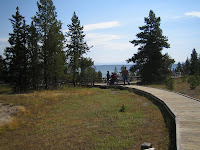
Day 3… Today, David and I checked out some wonderfully accessible walkways and saw Old Faithful Geyser. David said that watching the many magnificent geysers erupt was unforgettable. Talk about a steamy experience!

Day 4… More hiking along the miles and miles of accessible boardwalks. It seemed like we were on Mars as we passed by bubbling, stinky mud pots and fumaroles. David learned about Yellowstone's geothermal activity and features, while I couldn't help but notice how many other wheelchairs there were in the park.


Day 5… Today, David and I visited the majestic Grand Canyon of Yellowstone. There were paved walkways up to many different viewpoints of the canyon. David's favorite spot was Artist Point where the view of the Lower Falls in the vast yellow canyon was spectacular. David found the sound of the waterfall to be relaxing and peaceful.

Day 6... While driving through Yellowstone in a van rented from Wheelchair Getaways, we saw many wild animals including bison, moose, and elk. We found it amusing to sit in the van and watch the bison roll around in the dirt. These gigantic animals would also nonchalantly walk directly in front of our van, sauntering by like they owned all of Yellowstone National Park. The elk stayed mainly by the rivers; David and I could see them from a distance from the van. An anxious moose darted in front of our van, and then quickly hid behind some bushes. Yellowstone’s diverse wildlife is certainly a sight to behold!


Day 7… We said goodbye to Yellowstone and headed down to Grand Teton National Park. Like Old Faithful Snow Lodge in Yellowstone, we found more accessible lodging at the Jackson Lake cabins.

Day 8… I was not with David today. I needed to rest my weary parts. In his manual chair, David went up to the summit of the 10450-foot Rendezvous Mountain, via an accessible ski lift. I heard the view was incredible - snowcapped mountains, lush green forests, cool breezes, and the invigorating smell of the earth.

Day 9… Not with David again. He took a scenic boat ride across Jenny Lake. Many hikers used the boat ride to get to the other side the lake to hike through Cascade Canyon. Unfortunately, there aren't many accessible trails in the Tetons, but the views of the mountains from the boat and from the road are quite grand.

Day 10
Finally, I was back on duty. We visited the historic Chapel of the Configuration, a must-see in the Grand Teton National Park. Imagine going to a church that overlooks the Teton Mountain Range!

Day 11… David and I hiked along Coulter Bay, which is on Jackson Lake, at the northern rim of the Tetons. It was a difficult hike accessibility-wise, but we managed to do it. The backdrop is the beautiful Mount Moran.


Day 12... David took a raft trip along the Snake River, and that city boy saw a baby moose and a few bald eagles! Tomorrow we go home. Sure hope there aren't any unexpected travel calamities.

Day 13… I'm on the plane. So far the flight has been relatively uneventful. We just landed. Good to be home.
Here come the baggage attendants to help me down the conveyor belt. Oh no, there's a drop ahead and they don't have a good hold on me…..
CRASH!!


Epilogue from David: My Permobil wheelchair was fatally damaged from that final catastrophe. With some work, the airline did authorize a full replacement. I was without my specialized chair for several weeks, and still now am needing adjustments on the new chair. It is taking a long time to get both the function and the comfort adjustments correct for my needs. VERY frustrating! But, I refused to let the problems ruin a wonderful trip.

Friday, December 01, 2006

Birthday celebrations


As many of you know, thanks to Connie and Steve Kuusisto, today is my birthday, my 21st to be exact. Yes, now I am legal.

When I was little, I would eagerly look forward to my birthday, particularly my birthday parties. Whether it was playing freeze tag in a swimming pool, going to a Chicago Wolves ice hockey game, or playing basketball with a hoop that was lowered to my level, I had good times with my friends, playing games suited to my abilities and going to events that were wheelchair accessible. During my birthday parties, my differences didn't matter. I was just a boy having fun with his friends.

Thank you for the birthday wishes,

David

Monday, November 20, 2006

Thinking outside the box

The next Disability Blog Carnival will be hosted by Goldfish on Thursday, November 23. The theme for this carnival is "Different ways of going about things." I think this is a great theme, because we with disabilities learn something that everyone should know: you don't have to do something the way it's always been done.


I completed high school in six years. I studied two to four classes at a time making use of a variety of formats. Some classes, such as World History, English and Biology, I physically took at the school. Two afternoons a week, a tutor came to my house for one-on-one Spanish classes, allowing me to stretch out on the carpet and rest my body. Over the summers and during other “slow” times, my mom and I independently progressed through algebra and geometry. I completed lighter classes like health and consumer economics through correspondence courses. I took one semester of physics and one semester of chemistry online.

Why did I do things this way? How did this decision come about?

Through 14 years of raising triplets, each of us a unique individual, my parents had already learned to look at my needs and my goals as the first step in making this type of decision. We had already done elementary and junior high school in unique ways, so making careful decisions was nothing new to us.

Some goals for my high school years were: prepare for college by taking strong academic courses; continue with my singing and other hobbies, while exploring new interests; spend time with friends; strengthen my body with daily exercise; and let my body have the daily rest that it needs.

Our decision (actually, mainly my parents' decision in the early years) gave me the opportunity for success. I believe I am well prepared for college. Taking fewer classes at one time and spreading them over a longer number of years, allowed me to take some honors classes, including a philosophy class and Advanced Placement Spanish. I was able to complete math requirements, my most challenging subject area due to visual and conceptual difficulties, at my own pace and in a highly personalized way adapted to fit my learning style. An advantage of the online science classes was the opportunity to work in an interactive virtual lab. In the virtual lab, I got to weigh samples, fill test tubes, light a burner, and perform other tasks I am not physically able to do. (Unfortunately, the online chemistry class was highly disorganized and filled with errors, but that's another story.)

I continued my singing throughout high school. I really enjoyed taking voice lessons and singing at both my church and school. I sang in a few school musicals, but sadly and frustratingly, the school had difficulty accommodating my wheelchair, so I did not pursue this interest as much as I would have liked.

During high school, I had some fun times with friends, although like most students, I would have liked to have spent more time with them. The last two years were more challenging socially since my peers had already graduated.

When I would leave school after a partial day, both students and staff would frequently comment, "Oh, David! You're so lucky you get to go home." Little did they know, it was often difficult and painful for me to sit in my wheelchair for half a day, and I was going home to rest, recover, and do physical therapy exercises to strengthen my body.

My path through high school was an unconventional one. I still believe in my goals, but that didn't make life easy. I was juggling challenging academics, physical needs, hobbies, and a social life, while the obstacles of an inaccessible world, some people’s unsupportive attitudes, my pain, and my limited stamina often worked to sabotage my juggling act. At times, life was very stressful, and my time was always a precious resource.

My most difficult sacrifice was not graduating high school in four years with my peers. It was really tough watching my friends, many I had known for 12 years, start a new phase of their lives, all the while knowing that I would be returning to high school. So I wonder - was there any way that I could have met my goals while graduating in four years? I know I couldn't have taken a heavier academic load, and to cut my non-school interests, my social life, or my rest any further would have been unacceptable. So, I'm left wondering about the pull between my work on my body, which I did for several hours a day, versus graduating in four years. I don't know the answer to this question. Physical therapy has certainly improved my strength, stamina, and capabilities, and it has definitely reduced my pain. However, those benefits have come at a cost: the loss of time to meet my other goals and still graduate from high school in four years.

I am grateful to my parents for thinking “outside the box” and for teaching me how to make decisions. My parents have shown me some steps in how to make a decision: identify my values, priorities, and goals, then think of possible ways to make the goals happen. There are many tools in the toolbox to help make goals happen - brainstorming, seeing what others in a similar situation have done, and listening to what "experts" advise. It seems to me that in our society, many decisions are made for people with disabilities by simply doing what has always been done. Each of us needs to think for ourselves about our own individual goals, and then use our toolbox of tools to make the best decisions.

Thursday, October 19, 2006

Control

I interviewed “Brian”, a gentle man with a very quick wit. Brian told a story that highlights the issue of control. I think this is an issue that is often faced by people with disabilities.

In his 24 years, Brian has needed 37 surgeries to repair the life-sustaining shunt that was first placed in his brain as a baby. He said a shunt malfunction can occur at any time and requires immediate surgery for repair. Brian starts to realize his shunt is not working when he feels moodiness and lethargy. After a while he develops a severe headache, nausea, and a sensitivity to bright lights.

Brian must interrupt his life, head to the hospital, and have surgery. He is grateful to have a consistent primary surgeon for each surgery. However, Brian faces new resident doctors, fellow doctors, nurses and anesthesiologists each time. These healthcare providers play a pivotal role in the surgery’s outcome and Brian's comfort, yet they have no personal experience with his complex needs. It is a terrible combination: Brian’s shunt malfunction is unpredictable, he feels miserable, and he has changing healthcare providers. At one time, Brian intensely dreaded this experience.

With the help of his family and a psychologist, Brian realized he needed to gain control over this challenge. He thought of his needs during the surgical experience - dim lights in the operating room, IV anesthesia, extra warmth, and a calm, light mood, to name a few. Brian made a written list explaining these needs, which he keeps ready for hospitalizations. His instructions have been consistently followed by his healthcare providers. While Brian is not able to avoid the shunt repair surgery, he is able to maximize his control and make the experience as manageable as possible.

The issue of autonomy is huge one. Society is designed for those with able bodies. Buildings have stairs. Crosswalks have signs that only those with sharp vision can read. School programs, recreational activities, and community events often are one-size-fits-all. Health care providers learn textbook solutions to “problems", often overlooking the person. This societal design forces people who don't fit the cookie-cutter mold to be dependent on others to bridge the gap between society’s attitudes and our individualities. It is necessary to depend on a wide range of people - doctors, teachers, personal assistants, educational assistants, family, friends and neighbors every day. From eating, bathing and going to the bathroom; to be being pulled out of the classroom for therapy; to waiting for the special bus, people with disabilities depend on assistance for a variety of things. And when dependence comes in, autonomy and control go out.

Even under the best of circumstances - a willing, respectful, capable helper and a clearly defined task - it is difficult to rely on other people's help. In a classroom lecture, my assistants took notes for me, writing down the material they thought important in the style the thought best. In addition to the loss of personal preference, there's also a loss of control over timing; I have to wait to go the bathroom, to get a snack, to get my laptop computer. And when the circumstances aren't the best - an unwilling, disrespectful, incapable, helper along with an ambiguous task - autonomy and control can really suffer.

This issue of control is faced every day. When to be assertive? When to be aggressive? When to go with the flow? When to just give in?

I admire Brian's courage and creativity taking back control in a very difficult situation. By identifying his needs and preferences and sharing them with those he was dependent on, he makes a major change in his life.