Showing posts with label family. Show all posts

Wednesday, August 08, 2007

“…not this separate category of human beings”

Fifty years ago, babies born with developmental disabilities were routinely placed in institutions by their families under the direction of their family doctors. Health care professionals often advised families to forget the child, to have other children, and move on with their lives. It’s an appalling time in our history – babies and young children routinely abandoned and forgotten.

I think it’s important that we recognize and remember this cruel part of our history. Kay Olson from the Gimp Parade says,


“My personal thought on what happened 40+ years ago is that it was a tragedy for whole families and has undoubtedly had a lasting impact on how we view developmentally disabled people today. That is, we're still living with the legacy of those folks being segregated, made invisible, and devalued. It has impacted how we view developmental disability and the way we think of difference - we have all been taught implicitly by this history that people who are intellectually or developmentally different do not belong among us because they're dangerous, completely incompetent and lack any ability to contribute to society.”

While I was away last week, CNN covered the story of one man’s search for his sister. Jeff Daly made a documentary, “Where’s Molly?” in which he talks candidly about what it was like to be a 6 year old and have his sister sent away, rarely spoken of and advised to be forgotten. CNN shows a clip of the documentary and has an excellent article on Jeff’s and Molly’s experiences.

Kay’s words above are in a CNN blog that she wrote on this topic. She writes about he challenges of accurate diagnosis and the even greater challenges of predicting potential.

More from Kay on how the line between “us” and “them” is not so solid and clear cut:

“I think the main thing that nondisabled people don't necessarily know or understand is that developmentally disabled people are not this separate category of human beings. People tend to think, "We can do things. They cannot." And there's no line like that dividing all of us. There are shades of ability, varying talents that surface in surprising places. This is true for physical disabilities as well. Most of us, in the course of our lives, discover we have abilities or affinities for some things and lack talent elsewhere, so this idea that a certain class of people lack value or the ability to contribute inevitably underestimates and wastes a lot of human potential.”

I think it’s important that Jeff and Molly Daly’s story be heard. We cannot move forward until we acknowledge where we have come from. Jeff Daly is now working to reunite families affected by this tragedy. There is a national registry, called The National Find Families Registry, to help families affected by institutionalization to find each other.

Thanks to Elizabeth Cohen and Jennifer Pifer of CNN for bringing this important issue to the public’s attention. So often, it feels like the media’s stories about disabilities are superficial and artificial, “feel good” stories that are designed to entertain or “inspire” those without disabilities; stories that maintain difference, segregation, and the status quo. This is a real story with important ramifications, things to contemplate and learn, and also with actions to be taken.

Lastly, I have to say how much I admire Kay Olson’s style of advocacy. Her approach is thoughtful, reflective and encourages open dialogue. She is thought provoking and assertive without being hurtful or condescending. Kay is the quintessential advocate. I learn a lot from you, Kay - Thanks!

Monday, August 06, 2007

I Like Vacations!


I just returned from a beautiful trip to Wisconsin where I went bike riding on the Rails to Trails Elroy-Sparta bike trail, swam, played card games with my family, and went to a play.

I really look forward to going on a vacation. One reason is because it’s a welcome break from the everyday hassles of appointments, therapy, equipment, caregivers, etc, etc. Sometimes the everyday "stuff" of living with cerebral palsy can drive me crazy. It’s nice to get away, relax, explore new places, and hangout with my family. Of course, there are plenty of hassles with traveling, but I try not to dwell on them and try to enjoy the new adventures.


My parents bought this Duet bike 11 years ago. I love riding on it because I can feel the wind in my face and being on trails feels calm and peaceful. I cannot last too long on it because it doesn’t provide enough support. But that’s okay – it’s fun!


The Elroy-Sparta Bike Trail is neat
because it is fairly level (having been an old train track) and scenic. It also has many bridges that you cross and 3 long, dark, creepy tunnels that you walk your bike through.


The picture of me on the bench is when I was taking a lunch break at Gina’s Pies are Square. Yum!


I like to swim. We’ve figured out a way that works well for me. I wear a life jacket (it gives head support) and an inexpensive inner tube. When I’m not relaxing and floating on my back (like in this picture from a few years ago), I can paddle on my stomach and swim around. Moving in the water is so much easier for me than moving with gravity.


This card holder has seen me through many games of GO FISH, Old Maid, rummy, hearts, and poker. This trip we played Back Alley Bridge and Euchre.


Recently, my family has started taking in a play on some vacations. This time we went to the American Player’s Theatre in Spring Green, Wisconsin. It was fabulous!

I like vacations! Can't wait for the next one!

Friday, July 06, 2007

I'm back!


I'm resting and recuperating today from a wonderful and amazing trip.
This picture shows our group. The 3 gentlemen on the right side of the picture are Oscar, José Ángel, and Eduardo, Costa Rican disability activists and our hosts.
I'm posting my journal entries from earlier in the trip. I'll have more to say and pictures to post later. Thanks for all the good wishes!
sábado, 30 de junio
This was our last full day with our host families. In the morning our host mother, Marinella, took us to see a large church in their neighborhood. At 1 pm, we all joined the rest of the MIUSA group along with their host families , for an afternoon fiesta filled with food, socializing, singing, and dancing. Each host family was recognized and thanked by the each of us and also by the group. My host family, Toty (dad), Marinella (mom), and Marypaz (7 year old daughter), gave a short speech saying how he enjoyed having Ryan and me stay with them.
In the late afternoon, Minor, our taxi driver, picked Ryan and me up and we followed Toti, Marinella, and Maripas to Toti's sister and brother-in-law's house in the town of Tivas. We joined a family gathering of about 50 people, singing karaoke, dining, and having fun. It was very special.
The warmth and graciousness of my host family is incredible. Most of the people we have encountered here in Costa Rica possess this same warmth.
miércoles, 4 de julio
I've just returned from a relaxing e days at Carara National Park. We did lots of swimming and hiking and saw all sorts of wildlife. We went on a nicely accessible paved trail. We also went on a trail through the jungle and saw white-faced monkeys, McCaws, toads, iguanas lizards, and insects. There were a few rocky spots along the trail, but with teamwork, we got through them.
We also did some swimming at 2 beaches at the park. I floated in the water and found it warm, refreshing, and relaxing.
Carara is a beautiful national park, and they are looking to become more accessible. They asked for our suggestions. I appreciate this attitude and hope more people with disabilities will come to Carara.
This trip has gone by so fast. I can't believe it's coming to an end. I've met some wonderful people here and made what I hope will be lasting friendships.

Thursday, May 24, 2007

Disability Blog Carnival #15!


Kathryn from Ryn Tales has put together a rich assortment of posts that cover family and many other topics. I found some new blogs at this carnival, which is very exciting!

Monday, May 21, 2007

Reflections on Self-Love, Self-Worth, and Family

The 15th Disability Blog Carnival will be on the theme of family and disability. Able-bodied or disabled, all children learn their value from the people with whom they spend time.

From listening to the childhood reflections of others and from my own childhood experiences, I see that the young child with a disability is like a sponge, absorbing and internalizing the feelings and actions of family and caregivers. I've put together a composite of some of these reflections.

If I’m a little child I feel love and consequently, value when:

My mother's eyes, voice, and face light up upon seeing me, rather than becoming dark, dreary, and sad.

Even if I'm not able to verbally respond, my aunt talks to me using my name, rather than about me with impersonal pronouns as though I'm not there.

My grandfather spends time with me, telling stories rather than letting me sit alone in front of the television.

My uncle casually helps me get my jacket on so we can go the park, rather than making a big fuss like I'm slowing everyone else down.

My brother listens to me when I say, "you're treating me like a baby," and responds, "you're right, I'm sorry," rather than laughing at me or ridiculing me.

My grandmother enthusiastically greets me when I come to her house, rather than complaining about the work she had to do to accommodate my needs.

My father cleans up my drool or my dirty diaper with matter-of-fact simplicity, rather than shaming me about bodily functions over which I have little control.

My caregiver seeks to understand me when I ask a question, rather than becoming annoyed with me.

My stepmother holds me with a strong yet gentle touch making me feel safe and secure, rather than with a tentative hold leaving me to feel both dirty and frightened.

My young cousins follow the example of my inclusive adult relatives, finding ways to have fun with me, rather than giving up without even trying.

My godmother learns some sign language so she can communicate with me directly, rather than relying on my parents to be intermediaries.

My parents’ longtime friend rejoices in the fact that I exist, rather than talking about what a burden I must be.

My parents correct a neighbor who laments the hardship a disabled child must bring to their lives, and articulate my value, rather than list my needs and their fears.


The child's view of himself or herself is shaped by everyday life experiences and interactions. If a child with a disability feels loved, self-love and self-worth will follow.

Sunday, May 20, 2007

Friends' true views come out when a child gets sick

Update - Cicely came through her surgery well, and her mom shares the hospital experience here. The mom learned more about the ableist world than she'd care to believe is true. She also thanks everyone for their prayers.


"God is taking your burden away."

"Maybe it's for the best."

Dave Hingsburger shares a painful letter from parents who are shocked to hear these horrible comments from friends when their previously healthy little girl, Cicely, suddenly becomes very ill.

The mom asks Dave for "loud prayers" - for people to pray for Cicely and wish her and her family well.

Dave prays loudly and beautifully for Cicely, her family, and our world. "I pray that all the prayers today for Cicely, for her mother, for her father, be loud enough to shatter prejudice and bring down preconceptions. I pray that they are loud enough that barriers tumble and doors are blasted open."

Amen.

I join in prayer for Cicely, her family, and our world.

Tuesday, May 08, 2007

Protecting the Rights of Ashley X and Other Children

The Washington Protection and Advocacy System (WPAS) issued a report today on the results of their investigation of the "Ashley Treatment". (This agency investigates allegations of abuse and neglect of persons with disabilities in the state of Washington.) To read the full report of their findings and of the corrective actions required of the hospital click here.

"The sterilization portion of the "Ashley Treatment" was conducted in violation of Washington State law, resulting in violation of Ashley's constitutional and common law rights.

-The Washington Supreme Court has held that a court order is required when parents seek to sterilize their minor or adult children with developmental disabilities, and at the individual must be zealously represented by a disinterested third party in an adversarial proceeding to determine whether the sterilization is in the individual's best interests.
-Courts have also limited parental authority to consent to other types of medical interventions that are highly invasive and/or irreversible, particularly when the interest of the parent may not be identical to the interests of the child. Thus, the other aspects of the "Ashley Treatment" - surgical breast bud removal and hormone treatments - should also require independent court evaluation and sanction before being performed on any person with a developmental disability.
-The implementation of the "Ashley Treatment" also raises discrimination issues because, if not for the individual's developmental disabilities, the interventions would not be sought. Such discrimination against individuals because of their disabilities is expressly forbidden by state and federal law."

The WPAS explores why the violations occurred and states the corrective actions that Children's Hospital will take to protect the rights of children in their care. Some of those actions include: implementing "a policy to prohibit sterilizations of persons with developmental disabilities without a court order", implementing "a policy to prohibit growth-limiting medical interventions on persons with developmental disabilities without a court order", and including a disability rights advocate on the hospital ethics committee. The WPAS also states their plans to work with the public, health insurance companies, health care providers and disability advocates to improve services and supports for children with disabilities and their families.

Thursday, May 03, 2007

Thoughts on Blogging Against Disablism Day

Tuesday’s Blogging Against Disablism Day was a rousing success. I have read posts that were thought provoking, sad, insightful, funny, and informative - all exploring the many varied aspects and perspectives on disablism. Thanks to everybody who read and commented on my post.

I feel enriched, encouraged and invigorated.

I didn’t really have favorites from the day. Each post was unique - it's worth reading every single one.

Here’s a sampling of quotes from the day:

"Bullies and teachers had made it very clear to me which of my traits were desirable and which were not. Every time I saw myself I saw all those undesirable traits to my disgust and shame."

"He was my grandpa who had gone blind but that was somehow different from him being a blind person to me at that time."

"In fact, the U.S. Supreme Court has been so hostile to disability rights that Congress has started to consider legislation that's aimed at restoring the employment discrimination oversight powers to the ADA."

"So how did anyone get the idea that it's abnormal to need services?"

"Maybe labor and delivery rooms would sound like this,
'It's a boy! No hair, dark eyes, 46 chromosomes! Congratulations'
or
'It's a girl! Blond curly hair, blue eyes, and 47 chromosomes! Congratulations!'"


"OK, then. Where are you all? Where are the hordes and hordes of disabled bloggers of colour? Huh? What? Where are you?”

"Your finally getting married to the love of your life. Do you:-
(a) Hold your wedding at a restaurant without an elevator, with multiple stairs over many different levels so that your nephew, who is a power chair user, can’t attend.
(b) Invite your neice to be your bridesmaid, knowing that her brother won’t be there to watch her.
(c) Tell your nephew’s family, when they offer to pay the difference it would cost you to change the venue to a more powerchair friendly place, that the day is not about your nephew - it’s about you.
(d) Consider your family and hold the reception in an accessible restaurant/venue so that the whole family can enjoy the day and watch you get married."

Having chronic, invisible & controversial diagnoses also makes you aware that there’s a hierarchy of ‘acceptable’ illnesses.”

“Note that, discrimination against disabled people (at Ellis Island)wasn't a benign oversight, nor an unforeseen consequence of broader policy--disability discrimination was the policy.”

“So where are the self-reflective posts by nondisabled folks about ability, bodily privilege, fear of people with cognitive disabilities, or even angst about becoming impaired? Where is the recognition of participating in and privileging from an ableist culture?”

"We have a couple of people in our lives that have that "deer in the headlights" look whenever they're around us."

"So, there I am, in my wheelchair, waiting to cross the road. The total stranger next to me, having had a good, long, sideways stare, eventually says, “So what’s wrong with you then?”
My options would appear to be:
tell them what my disability is - which is no secret, but really none of their sodding business
say 'You first - what’s wrong with you?' - which will confirm them in their opinion that all disabled people are peculiar and embittered - after all, they were just trying to be nice!"


“. . . what if there was ableist discrimination, if the able-bodied encountered whispers, inaccessible buildings and transport, stares, intrusive and rude comments, and more?”(great 3 minute video demonstrating this point)

Monday, April 30, 2007

Sandbox Lessons

Blogging Against Disablism Day, May 1st 2007

I was listening to the song, “You’ve Got to be Carefully Taught” from the musical South Pacific. The song asserts that children are not born racist, they must learn to be racist. I think that same truth applies to ableism. Children are not born believing that some differences make a person inferior; they have to be taught. It's easy to see how Jerry Lewis’s Muscular Dystrophy Telethon, inaccessible buildings, overt discrimination, or the common use of words such as "retard" or "cripple" teach ableism. It is more challenging to realize that even well-intentioned people, themselves products of the culture we live in, can inadvertently foster the ableist paradigm in children.

My mom remembers a telling story that took place on an ordinary day many years ago. My two sisters and I were about 4 years old at the time (we’re triplets) and were playing in our backyard sandbox. It was a warm, sunny summer afternoon. My sisters were running back and forth between the sandbox and the hose to get water for our sandcastles. I was lying on my stomach, as I often did, playing in the sand with my hands, my shovel, and my truck. We were laughing and having fun.

Unbeknownst to my sisters and me, a six year old boy who was visiting our next door neighbors was intently watching us through the chain link fence.

At some point, one of my sisters went near the fence, and the boy asked her, “Does he walk?”

My mom says she held her breath, ready to jump into the conversation and stand up for me. Ever the advocate, she would've said something sappy like, “He can’t walk, but he's really good at playing in the sand.”

Had my protective grandparents been around, one of them might have scolded the boy, “Hey! That’s a rude question!”

An educator or social worker, seeing a potential peer socialization experience for me, might have answered with a heavy, deliberate sigh, “No… he's not able to walk.” Then with forced enthusiasm, “Why don't you go play with him? It doesn't have to be very long, just a few minutes. You'll feel good helping the boy."

A healthcare provider, intending to minimize the importance of physical differences, might have lectured the boy on my condition of cerebral palsy, "The motor area of his brain was damaged because he was born too early. This damage causes him not to have good control of his arms and legs. Even though his body is different from our bodies, he's really just like us.”

The boy's dad, not wanting his son to be offensive or rude, might have pulled his son away from the fence, “Shhh…. Don't stare! Don't make him feel bad."

On the surface, these responses to the boy's question may seem appropriate. But imagine, if you will, the boy at the fence asking my sister a different question. Suppose he asked, "does he have red hair?"

"No, he doesn't, but he's really good at playing in the sand."

"Hey! That's a rude question!"

Heavy sigh, “No… he doesn't have red hair.” Forced enthusiasm, “Why don't you go play with him? It doesn't have to be very long, just a few minutes. You'll feel good helping the boy."

"He’s genetically heterozygous for the brown haired trait. Even though his body is different from our bodies, he's really just like us.”

“Shhh…. Don't stare! Don't make him feel bad."


So, how did the four year old's and six year old’s interaction play out that sunny summer day?

Not assuming any hidden meaning to the boy’s “Does he walk?", my sister simply said, "no."

The boy accepted her simple answer to his simple question. Then he moved on to his more important question, "Can I play? We could use my yellow dump truck to move the sand.”

The boy, and soon the neighbor kids, came over. The sand castles got bigger, the laughter louder. We all had a great time.


Be sure to check out the many other posts for Blogging Against Disablism Day. Thanks, Goldfish for organizing this event.

Thursday, March 22, 2007

Dehumanization: Two powerful posts

Ruth, from Wheelie Catholic, writes a personal, real life post about the issues people with disabilities face with personal care attendants (and I would add often with other service providers, too.) She points out some of the ways disrespect can be manifested by caregivers in the lives of their clients. She also addresses the reluctance many people feel in bringing up these issues for fear of losing much needed service. One of the commenters who details neglectful care does not leave his/her name, because "I'm afraid."

Steve Kuusisto, at Planet of the Blind, sadly reflects on the disrespect of one group of people by another group of people when the issue of combining schools is raised in his town. He wearily speaks of the disdain of some members of the deaf community towards others with disabilities. The disability hierarchy rears its ugly head again.

Monday, March 19, 2007

Independent Living

Last week, at my request, an occupational therapist and 2 rehabilitation engineers from the University of Illinois Chicago Assistive Technology Unit came to my house for an evaluation of a couple of my needs – a cell phone that I can use independently and a custom tray that will allow me to use my laptop, voice recognition software, and large Kensington trackball in my wheelchair. I had used the A.T. Unit’s services once before for a household adaptation and had had a very positive experience. Usually when I meet with service providers, I prepare myself for disappointment – disappointment in the attitude, capabilities, effort, and vision of the service provider, because that is the norm. But, this time, based on my past experience with A.T. Unit, I was feeling cautiously optimistic. I was not let down.

Here’s how the visit went…

First, they came on the same day that the said they would, and they even called to let me know that they were going to be a little late. Courteous. Respectful of the value of my time.

When they came in the door, they made eye contact with me, introduced themselves, and said hello to me. They were respectful to my mom, but recognized me as their client. More respect. Professionalism.

Then they asked me about my needs and my goals. More respect. They didn’t ask about my diagnosis or my “problems”; they weren’t relevant to the problem-solving. No pity, no shame, no getting off track.

The A.T. service providers never questioned the value of my goals; they accepted them as worthy, because I said they were important to me. Client respect.

The 3 providers were incredibly detailed in their evaluation of my needs – taking measurements and photographs, and asking specific questions to make a thorough assessment. They bounced creative ideas off of each other and off of me and my mom. Goal-oriented teamwork with a real effort to address my needs.

I am excitedly looking forward to see their solutions. To have my own cell phone would allow me control over my own phone calls. It would allow me to be out without a personal assistant, knowing that I could call for assistance if needed. The adapted tray will allow me to use my laptop computer set-up at college for note-talking, paper-writing and any other work that I need to do.

The Assistive Technology Unit at UIC is an example of an organization that is supportive of my life goals, supportive of my desire for independent living.

If I want to live independently, does that mean that I have to do everything for myself?

No. If self-sufficiency were the definition of independent living, then nobody lives independently these days. The pioneer families may have grown their own grain, milled their own flour, baked their own bread, sewed their own clothing, and built their own houses. But today, everyone I know lives interdependently within their community, both receiving from and contributing to the community's well-being. We have farmers, carpenters, artists, teachers, housekeepers, computer technicians, journalists, etc., each offering to the community and each receiving from the community.

I see myself living interdependently in my community. I know that I have talents to offer, and I know others have talents that I can benefit from. I hope I can put everything together, and be in charge of my own life, making my own decisions. Interdependence and autonomy is my definition of independent living.

I'm willing to work hard to develop my talents, and I realize that I will have to make some compromises, maybe where and how I live. What I don't want to compromise is my autonomy, my ability to make choices and decisions for myself and for my life.

I think the greatest obstacle to my autonomy is society's reluctance to recognize me (and others) as a full member of the community, to recognize that the talents I give and the services I receive are on the same par as those of every other member of the community. The services that I need are not charitable services that a provider can provide when he or she finds it convenient. I do not need to be grateful for jobs done halfway or inadequately, nor accepting of disrespect of my personhood.

My need for clearing of snow-covered curbcuts is as valid as a driver’s need for clearing of snow-covered streets. My need for a personal care assistant is no less valid than a working parent’s need for capable childcare. My need for prompt, precise repair of a broken piece of necessary medical equipment needs to be respected as much as the need for any community member to have a repair of a gas leak in their basement. My need for a textbook on tape on the first day of class is no different than my classmate’s need for a hardcopy of the textbook on the first day of class.

My experience with the UIC Assistive Technology Unit gives me hope for the future –hope in others’ ability to respect and serve me, and hope in my ability to contribute to others.

Description of picture: Me, laying on my mat table and working on my laptop with my trackball and voice recognition equipment

Tuesday, March 13, 2007

Kay Olson: "Anniversary--Escaping Institutionalization"

Reflecting on the fact that the outrageous conditions faced by our veterans at Walter Reed Hospital’s outpatient facilities is similar to the conditions faced by many non-veterans every day, Carol Marfisi, from Disability Studies, says,

"What disturbs me is that the same deplorable conditions and substandard care and services are every day occurrences in the lives of many people with disabilities, as well as the elderly, who are living in nursing homes and long-term care facilities. The United States government is quick to covet credit as the world's most developed and advanced country yet under its very eyes, we see physical, emotional, and sexual abuse in these facilities."

Kay Olson reflects on her 1 year anniversary of “escaping institutionalization”. It is a powerful post. Please, please go read it. Without the diligent advocacy of her parents and rehabilitation staff, she would have fallen victim to the cavalier attitude of an insurance agent who wanted to place her in a nursing home unfit for habitation. Kay believes that had she gone to that nursing home, she would have died from respiratory problems or from some other cause.

Thank you, Kay, for sharing such a personal and painful story. I have learned a lot from you over the past 6 months about advocacy, dignity, inclusion and attitude.

I found Kay’s post upsetting for many reasons. Here are a few.

-The nursing home conditions she describes are appalling. They remind me of the conditions I read about in New Orleans’ nursing homes, the conditions that didn’t come to light until after we saw people abandoned with Hurricane Katrina.

-I am amazed at how “easy” it is for a person to be dumped, abandoned and discarded.

-I can see this experience being a possibility in my future.

-I have parental support. Kay has parental support. What about people who don’t have a support system in place?

-Kay’s story may be the exact situation that Ashley X’s parents were afraid of, a fear that led them to mutilate their daughter under the false assumption that she would then be “safe” from the horrors of institutionalization.

-Maybe this is how some people jump to the conclusion that euthanasia is a choice. The nursing home option seems to be saying, “Your life is worthless. It’s best for you to die, and we’ll give you a push.”

We need change! As a society our values and priorities, and the resulting allocation of resources are very wrong. Tragically, immorally wrong.

Saturday, February 24, 2007

“Martin’s Answer to the Ashley Treatment”

I found this new website from Ruth, at Wheelie Catholic.

Introducing, Martin.


Martin lives with his parents and 3 brothers in my homestate of Illinois. Martin's parents share their experiences raising a child with a disability similar to that of Ashley X. They share their philosophy of life, along with wonderful pictures of their family on their recently started blog.

Here’s what they say,

“Our intent is show that extreme measures are not an option. Our child's name is Martin and he has disabilities as severe, if not more so, than Ashley. Martin lives at home, is growing to a normal size and stature, and he will continue to do so without medical intervention to stunt his growth.”

Welcome to the blogworld, Martin and family! I look forward to reading more of your blog.

And, finally, thanks to Koufax-award-nominated Blue, whose Saturday Slumgullions are always on top of current events, links to two recent posts about the Ashley Treatment:
Medical Ethics Malfunction, by Reuben Apple and Protest From A Bad Cripple -The Ashley Treatment and the Making of a Pillow Angel by William Peace.

Picture from Martin's blog

Friday, February 23, 2007

John Hockenberry – “Ashley X: Straight on till mourning”

The lack of public outrage about the Ashley Treatment continues to be on my mind. And I know that the Ashley Treatment is still influencing others as well: Amanda who dedicates her video, In My Language, to “Ashley X and everyone else who’s ever been considered not thinking, not a person, not communicating, not comprehending and so on and so forth”; Wheelchair Dancer, who wants her family to “understand the world (she) lives in”; Blue who feels a renewed call to “speak (her) own truth”; Penny who has been reading about Chinese foot binding.

I greatly appreciate hearing John Hockenberry’s perspective, Ashley X: Straight on till mourning. He examines the controversy from several angles, particularly addressing the role of parents in society. It’s a must read, an articulate piece that pulls together so many points and gets right to the heart of the issues.

Here are a few excerpts:

"In a kind of grim Peter Pan story in reverse Ashley’s parents believe they have guaranteed their ability to care for their daughter as they themselves age by keeping her forever a child."
and
"It is odd to hear the many criticisms and challenges to the Ashley Treatment (a considerable number from disability activists) called ‘lofty talk about human dignity.’ It’s curious to imagine that human dignity is somehow removed from reality while the Ashley family’s lofty talk about parental love and nurturing that forms the basis for their decision to medically stunt their daughter’s growth and interrupt her biological development is, in contrast, a response to pragmatic reality."
and
"Disability has nothing to do with the morality of the Ashley Treatment."

and
"Regardless of their love and affection for their daughter their decision to remove her breasts and uterus and maintain her in a state of pre-puberty is not a parental decision. It is more the kind of control one might enforce on a pet to manage the relationship. It is something a farmer managing the productivity of his or her operation would naturally enforce on livestock. This would be done humanely, morally, and no-doubt with considerable tender affection and love for the subjects. There would be no outcry and no controversy, yet no one would confuse these acts of husbandry as parenthood."


Please go read it. It will make you think.

If you’d like to sign “A Statement of Solidarity for the Dignity of People With Disabilities - A Reaction to the Ashley Treatment”, go here.

Sunday, January 07, 2007

A mother and father’s betrayal

Update: See January 15 post.

Ok. Here I go. I am tired of the profound sadness that is filling my head 24/7.

When I first heard about the “Ashley Treatment”, I was appalled. I checked out the family’s website. I was more appalled.

I have been reading insightful, articulate reflections* by fellow bloggers. My family and I have talked on and on and on about the situation. But, still, I had remained a little detached (not much!) and didn’t want to write about the topic. My interview project and my blogging have been fun, up until now. But, tonight, I have changed my mind.

Ashley has cerebral palsy. I have cerebral palsy. But, most importantly, Ashley is human. I am human. Ashley is me. I am Ashley. And you are Ashley, too.

Ashley’s “parents” are afraid that their daughter would grow physically to be a young woman. I am a young man. I have a severe disability. I cannot sit up by myself, I cannot walk, I cannot go to the bathroom independently, I cannot prepare meals, I cannot use utensils very well. I cannot wipe my own butt. I drool. I weigh about 140 pounds, I am 5’9” tall. I am uncomfortable spending a lot of time in my wheelchair, I prefer to lay on the carpet. My mom can no longer lift me off the floor; my dad can barely lift me off the floor.

I have been disrespected and mistreated at times in my life. My parents have always gone to bat for me and now, with me. What strikes me tonight about the “Ashley Treatment” and has brought me to tears is that the very people in all of society whom this child should trust, have betrayed her. When you grow up so dependent, so vulnerable, you need someone to love you wholly and unconditionally. The rest of society may disrespect you and put you down and make you think less of yourself and make you think you are not a human being, but your parents?! Your parents?! I am my parents’ child, they know that I am a human being. Not an angel, not a pet. And, I learn from them that as a human, I have human dignity.

Ashley’s parents have committed the ultimate betrayal. They have treated their daughter as less than human, not worthy of dignity. But the truth is, they have lost their dignity.


*The thoughtful, insightful reflections:
Blue/Kay Olsen: Ashley Treatment

Imfunnytoo: It begins with Ashley

Mary Johnson: Ashley’s treatment in the media

Penny Richards: Sigh

Dream Mom: Pillow talk, the debate over the Ashley treatment

Corey Silverberg: When disability gets in the way, stunt it.

Nufsaid: The Ashley Treatment

Wheelchair dancer: Human Rights

Ruth Harrigan: The Ashley Treatment

Updated-
Thirza Cuthand: I am not responsible for your discomfort

Sunday, December 10, 2006

My Wheelchair's Vacation Story

Before I sent my trusty Permobil off to the wheelchair graveyard a few months ago, I found this travelogue secreted away under the cushion. It reads as follows:

Day 1... Today I took a few unexpected side trips and saw the inside of many airplanes. I missed David! He went to Jackson, Wyoming, but I went to Denver, Los Angeles, San Francisco, and back to Denver for the night. A whirlwind adventure, for sure! I still feel a little woozy and have some bumps and bruises from the mishaps and mishandlings. I wonder what he's up to in Jackson. Sure hope I’ll be with him tomorrow.

Day 2... Hooray! I was reunited with David. Frankly, I got pretty tired of touring airplanes and airports. It's nice to start the vacation. David was relieved that with a few adjustments and Band-Aids, my condition was acceptable to continue with the trip. I know I'll need some major surgery when we get home, but for now good times are ahead.

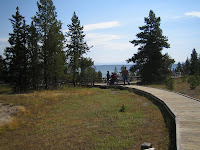
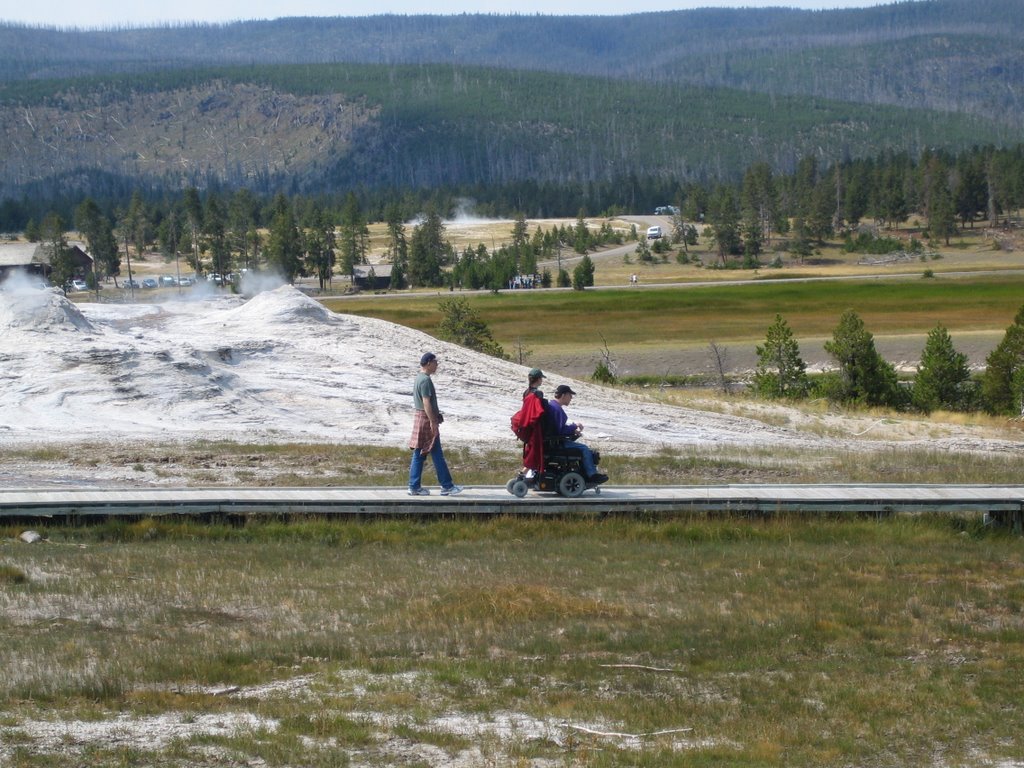
Day 3… Today, David and I checked out some wonderfully accessible walkways and saw Old Faithful Geyser. David said that watching the many magnificent geysers erupt was unforgettable. Talk about a steamy experience!

Day 4… More hiking along the miles and miles of accessible boardwalks. It seemed like we were on Mars as we passed by bubbling, stinky mud pots and fumaroles. David learned about Yellowstone's geothermal activity and features, while I couldn't help but notice how many other wheelchairs there were in the park.


Day 5… Today, David and I visited the majestic Grand Canyon of Yellowstone. There were paved walkways up to many different viewpoints of the canyon. David's favorite spot was Artist Point where the view of the Lower Falls in the vast yellow canyon was spectacular. David found the sound of the waterfall to be relaxing and peaceful.

Day 6... While driving through Yellowstone in a van rented from Wheelchair Getaways, we saw many wild animals including bison, moose, and elk. We found it amusing to sit in the van and watch the bison roll around in the dirt. These gigantic animals would also nonchalantly walk directly in front of our van, sauntering by like they owned all of Yellowstone National Park. The elk stayed mainly by the rivers; David and I could see them from a distance from the van. An anxious moose darted in front of our van, and then quickly hid behind some bushes. Yellowstone’s diverse wildlife is certainly a sight to behold!


Day 7… We said goodbye to Yellowstone and headed down to Grand Teton National Park. Like Old Faithful Snow Lodge in Yellowstone, we found more accessible lodging at the Jackson Lake cabins.

Day 8… I was not with David today. I needed to rest my weary parts. In his manual chair, David went up to the summit of the 10450-foot Rendezvous Mountain, via an accessible ski lift. I heard the view was incredible - snowcapped mountains, lush green forests, cool breezes, and the invigorating smell of the earth.

Day 9… Not with David again. He took a scenic boat ride across Jenny Lake. Many hikers used the boat ride to get to the other side the lake to hike through Cascade Canyon. Unfortunately, there aren't many accessible trails in the Tetons, but the views of the mountains from the boat and from the road are quite grand.

Day 10
Finally, I was back on duty. We visited the historic Chapel of the Configuration, a must-see in the Grand Teton National Park. Imagine going to a church that overlooks the Teton Mountain Range!

Day 11… David and I hiked along Coulter Bay, which is on Jackson Lake, at the northern rim of the Tetons. It was a difficult hike accessibility-wise, but we managed to do it. The backdrop is the beautiful Mount Moran.


Day 12... David took a raft trip along the Snake River, and that city boy saw a baby moose and a few bald eagles! Tomorrow we go home. Sure hope there aren't any unexpected travel calamities.

Day 13… I'm on the plane. So far the flight has been relatively uneventful. We just landed. Good to be home.
Here come the baggage attendants to help me down the conveyor belt. Oh no, there's a drop ahead and they don't have a good hold on me…..
CRASH!!


Epilogue from David: My Permobil wheelchair was fatally damaged from that final catastrophe. With some work, the airline did authorize a full replacement. I was without my specialized chair for several weeks, and still now am needing adjustments on the new chair. It is taking a long time to get both the function and the comfort adjustments correct for my needs. VERY frustrating! But, I refused to let the problems ruin a wonderful trip.

Friday, December 01, 2006

Birthday celebrations


As many of you know, thanks to Connie and Steve Kuusisto, today is my birthday, my 21st to be exact. Yes, now I am legal.

When I was little, I would eagerly look forward to my birthday, particularly my birthday parties. Whether it was playing freeze tag in a swimming pool, going to a Chicago Wolves ice hockey game, or playing basketball with a hoop that was lowered to my level, I had good times with my friends, playing games suited to my abilities and going to events that were wheelchair accessible. During my birthday parties, my differences didn't matter. I was just a boy having fun with his friends.

Thank you for the birthday wishes,

David

Monday, October 09, 2006

Relationships

I’ve been thinking about the connection between disability and friendship.

What makes a friend? What do I look for in a friendship? What do I like about my friends?

Well…

I look for people who like to think “outside the box” and challenge the status quo. Why do things the way they’ve always been done, just because they’ve always been done that way? People who want to make the world a better place excite me.

I enjoy people who make music. Musicians are fun people who know how to have a good time.

I enjoy watching sports and talking about sports with friends. Go Bears!

I enjoy exploring nature with friends – nothing like a hike in the woods on a fall day.

I look for people with a positive life attitude – a positive, realistic view of the world. Not sappy or phony – but a “taking the good with the bad” attitude and honestly realizing that there is so much good.

I look for people who like to learn and grow; people who are humble enough to recognize that they don’t know all the answers and who like to have challenging conversations.

I enjoy people who like to play. A game of poker with my buddies makes a fun Friday evening. And, I finally have a fantasy football team in first place!

I look for people who work hard to fulfill their passion.

I like people with a sense of humor. Laughing is fun. Ever listen to “Wait, Wait Don’t Tell Me?”


Notice that “disability” is not on my list. Some of my friends have disabilities, some don't. It's not a factor.

But much of society has it on their list.

Some people, both peers and adults, have avoided me because of my “outside” – perhaps my drooling, being in a wheelchair, limited use of my hands. Others, perhaps deluding themselves into thinking they were “open-minded”, talked down to me or were my “friend” only when convenient for them.

A visible disability presents superficial “differences”. But, it’s the inside qualities that matter in real friendships. We can share so much in common with each other, but we need to get to know what’s on the inside to find out. Seeing a person simply as his or her disability is a roadblock to a real relationship, and, sadly, both people end up missing out.