Showing posts with label different ways of doing things. Show all posts

Wednesday, November 28, 2007

Disability as Culture

Check out Cross-Cultural Communiques from Andrea’s Buzzing About. When I was writing an essay about my educational experiences for my English class, I noted the tremendous difficulty that able-bodied people had in understanding my experiences when they were so different than their own. Andrea broadens the discussion to look at cross-cultural relationships. She shares a list by an unknown author designed to address "…the assumptions we mentally trip over when working with people from other national, religious or ethnic cultures." Andrea notes, "I rather doubt that the author(s) considered how broad the cultural spectrum can be."

The first one on the list is "What seems to be logical, sensible, important, and reasonable to a person in one culture may seem stupid, irrational, and unimportant to an outsider." All twelve make you think.

Sunday, September 09, 2007

Going to college: high-tech, low-tech, mom-tech

This week I started college at Dominican University in River Forest, Illinois. I'm excited and looking forward to a challenging (in the good sense!) and rewarding experience.

It's taken me a couple months to address my unique needs for college. I know from other experiences that planning makes a big difference. But, I also know that even with the best planning, unpleasant surprises and delays occur.

I have a few new things to help meet my various needs - some high-tech, some low-tech, and some designed with the tools of improvisation (like velcro, duct tape, items intended for other use) with which every person with a disability becomes all too familiar. Like other times in my life, many adaptations were designed by a creative genius, a.k.a. my mother, because there was no product that exactly worked for me.

Improvisation is a key aspect of living with a disability. Many times there are no products available to meet the individual’s specific purpose. You have to use your imagination and be creative. In the basement, my family has a box filled with Velcro, extra padding, spare parts, and a ready supply of duct tape.


The staff from the University of Illinois Assistive Technology Unit, who I started meeting with last March, designed and installed a small flip-out tray for my Kensington Trackball. They designed it so that I can store the little tray under my wheelchair tray, and independently move it into place when needed. They also designed my armrest to flip open to give my wrist added support while using the trackball. Now I can use my laptop computer while in my wheelchair! At this time, though, I still prefer to lie on the floor and use the computer, including my Dragon software, because then I can have all my papers on the floor to look at and sort through. And, I can roll around and change position as needed; my back doesn't get quite as sore.


I needed to get a cell phone for school. My parents spent a lot of time checking out the possibilities. Unfortunately, the UIC AT people didn't have advice on particular phones. Access World had an article on cell phones, and Planet Mobility had information on a 100% voice activated phone. Also, Jitterbug makes an easy to use cell phone. None of those exactly met my needs. We went to the Verizon store and picked a phone that seems like a good match for me - the GzOne phone. It's a rugged phone, made to stand up to shock (i.e. accidental dropping) and also water resistant. The buttons were not too hard to operate, and we programmed the numbers I'd use the most into speed dialing, so that I can call them with the press of one button. I decided against a Bluetooth headset because I am not able to get the headset on and off by myself. I also was not able to flip the phone open in its original form. We put the phone in a holster, and taped an old caribiner hook on the back. Now I had something I could grip with my left hand. Then my mom threaded a string through two washers and taped it all to the top of the phone. With my right hand, I can grab the string and flip open the phone.

My mom found two different baby stroller cup holders and set up one for my water bottle. The other one she rigged up to be attached to the first one and to hold my cell phone. She also attached a strap to the phone to make it easier to pull out of its cup holder.

I also bought the Day Cruiser bag from Wheelchair Gear, which is attached to the left side of my chair. With practice, I am getting the hang of opening the velcro flap and getting into the bag. We may have to remove the velcro. We attached a key chain holder to the zipper compartment with the hope that I can get the hang of using that compartment also.


I have also worked with the university to address my needs. This semester, I’m only taking two classes to make it easier to juggle academics, learn the ins and outs of addressing my needs, do physical therapy, and, of course, have time for fun stuff.

I emailed my professors over the summer to explain some of my needs. I ordered audio version of my textbooks from RFB&D and my local branch of the National Library Service for the Blind. And, I just got a subscription with Bookshare. (Even with all that planning, I still don't have all my books in an audio format!)

After the first day of class, I met with my professors to talk about what I needed to succeed in their classes. I was pleased that they were both receptive, and the meetings went well.

Each professor is helping me to find a classmate to be my notetaker. The classmate will make a copy of his or her notes for meand get paid $9 dollars an hour by the Department Of Rehabilitation Services Vocational Rehab (DORS). DORS has been a great support thus far - helping with some of my tuition and also with books and equipment costs.

I don't have the care of my personal needs (eating, bathrooming) figured out yet. With the light load I am taking this semester, I'll just address those needs at home for now.

I’m looking forward to the start of this college adventure. I don't think I'll be doing any interviews in the near future, but I still plan to continue blogging and sharing my two cents. Sorry, the blogosphere can’t get rid of me!

Monday, May 07, 2007

First Loss

Each summer when I was little, my family would rent a cabin in Wisconsin. For me, a highlight of the vacation would be an afternoon of horseback riding. My dad and I would ride double on the horse. I would sit in front of him, leaning on him for support. My dad would hold me tight and keep me stable. I loved it! My horse was always a calm and friendly one. I would pet the soft, smooth fur and talk to my horse by name. I felt safe, while experiencing the up-and-down rhythmical movement of the horse. I especially enjoyed the thrill of the horse galloping. We'd ride a trail that went through the woods, feeling the cool breeze, listening to the chatter of the birds, and smelling the fragrant flowers and pine forest. The woods felt majestic and peaceful, and I felt contented exhilaration on that one hour trail ride.

One summer, when I was about eight years old, I was totally caught off guard when my dad told me he could not safely ride double with me anymore. I was shocked. I couldn't believe it. Why couldn't I do something that the rest of my family could do? Would I be able to go horseback riding when I got older? How could it be that my strong dad could not keep me safe on a horse? What else wouldn't I be able to do? I felt really sad about the loss of horseback riding on summer vacations.

I was at a turning point in my life. For the first time, I realized that my cerebral palsy presented me with some limitations. You might wonder how I made it to eight years old without recognizing this point. I suppose part of the reason had to do with cognitive development. But, I think a large part had to do with my parents’ commitment to do activities that the whole family could do. Also, my same age sisters didn't know any differently either.

There were other times as a child, when I saw able-bodied children doing things I wished that I could do. I had watched kids go off to baseball practice and would have loved to have joined them. Bike riding and rollerblading also looked like a lot of fun.

Although missing out on some activities made me feel down at times, I can't say that, as a child I ever wallowed in sadness. There was just too much life to be lived. There were so many fun things that I did do, like singing in a choir, participating in a theater summer camp, and swimming with an inner tube and lifejacket (I could play a mean game of freeze tag in the freedom of the water). My parents altered a Baby Jogger racing stroller so that we could go on hikes in the woods. I continued to enjoy the cool breeze, the chatter of the birds, and the fragrant smells of the forest.

Description of 1st picture: I'm about 6 years old, sitting with my dad on a brown horse getting ready to go on a trailride into the woods on a beautiful, clear day. I have a smile on my face.
Descripton of 2nd picture: I'm about 10 years old, sitting in a customized 3 wheeled stroller on a hiking path in the woods on a beautiful day. I am smiling. My dad is next to me.

Thursday, November 23, 2006

Carnival Day!

Disability Blog Carnival #4 is up! Goldfish did a spectacular job putting together a fascinating variety of posts on the topic taking a different approach to things and the lessons learned about flexibility and adaptability. It's great - check it out!

Monday, November 20, 2006

Thinking outside the box

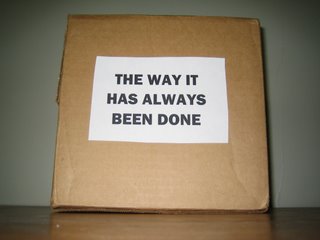
The next Disability Blog Carnival will be hosted by Goldfish on Thursday, November 23. The theme for this carnival is "Different ways of going about things." I think this is a great theme, because we with disabilities learn something that everyone should know: you don't have to do something the way it's always been done.

I completed high school in six years. I studied two to four classes at a time making use of a variety of formats. Some classes, such as World History, English and Biology, I physically took at the school. Two afternoons a week, a tutor came to my house for one-on-one Spanish classes, allowing me to stretch out on the carpet and rest my body. Over the summers and during other “slow” times, my mom and I independently progressed through algebra and geometry. I completed lighter classes like health and consumer economics through correspondence courses. I took one semester of physics and one semester of chemistry online.

Why did I do things this way? How did this decision come about?

Through 14 years of raising triplets, each of us a unique individual, my parents had already learned to look at my needs and my goals as the first step in making this type of decision. We had already done elementary and junior high school in unique ways, so making careful decisions was nothing new to us.

Some goals for my high school years were: prepare for college by taking strong academic courses; continue with my singing and other hobbies, while exploring new interests; spend time with friends; strengthen my body with daily exercise; and let my body have the daily rest that it needs.

Our decision (actually, mainly my parents' decision in the early years) gave me the opportunity for success. I believe I am well prepared for college. Taking fewer classes at one time and spreading them over a longer number of years, allowed me to take some honors classes, including a philosophy class and Advanced Placement Spanish. I was able to complete math requirements, my most challenging subject area due to visual and conceptual difficulties, at my own pace and in a highly personalized way adapted to fit my learning style. An advantage of the online science classes was the opportunity to work in an interactive virtual lab. In the virtual lab, I got to weigh samples, fill test tubes, light a burner, and perform other tasks I am not physically able to do. (Unfortunately, the online chemistry class was highly disorganized and filled with errors, but that's another story.)

I continued my singing throughout high school. I really enjoyed taking voice lessons and singing at both my church and school. I sang in a few school musicals, but sadly and frustratingly, the school had difficulty accommodating my wheelchair, so I did not pursue this interest as much as I would have liked.

During high school, I had some fun times with friends, although like most students, I would have liked to have spent more time with them. The last two years were more challenging socially since my peers had already graduated.

When I would leave school after a partial day, both students and staff would frequently comment, "Oh, David! You're so lucky you get to go home." Little did they know, it was often difficult and painful for me to sit in my wheelchair for half a day, and I was going home to rest, recover, and do physical therapy exercises to strengthen my body.

My path through high school was an unconventional one. I still believe in my goals, but that didn't make life easy. I was juggling challenging academics, physical needs, hobbies, and a social life, while the obstacles of an inaccessible world, some people’s unsupportive attitudes, my pain, and my limited stamina often worked to sabotage my juggling act. At times, life was very stressful, and my time was always a precious resource.

My most difficult sacrifice was not graduating high school in four years with my peers. It was really tough watching my friends, many I had known for 12 years, start a new phase of their lives, all the while knowing that I would be returning to high school. So I wonder - was there any way that I could have met my goals while graduating in four years? I know I couldn't have taken a heavier academic load, and to cut my non-school interests, my social life, or my rest any further would have been unacceptable. So, I'm left wondering about the pull between my work on my body, which I did for several hours a day, versus graduating in four years. I don't know the answer to this question. Physical therapy has certainly improved my strength, stamina, and capabilities, and it has definitely reduced my pain. However, those benefits have come at a cost: the loss of time to meet my other goals and still graduate from high school in four years.

I am grateful to my parents for thinking “outside the box” and for teaching me how to make decisions. My parents have shown me some steps in how to make a decision: identify my values, priorities, and goals, then think of possible ways to make the goals happen. There are many tools in the toolbox to help make goals happen - brainstorming, seeing what others in a similar situation have done, and listening to what "experts" advise. It seems to me that in our society, many decisions are made for people with disabilities by simply doing what has always been done. Each of us needs to think for ourselves about our own individual goals, and then use our toolbox of tools to make the best decisions.