Showing posts with label boxes. Show all posts

Thursday, June 14, 2007

Carnival Day!


The theme of Carnival #16 is "Borders", and it's up now over at Pilgrim Girl. Jana starts by sharing a recent experience in her own life.


"A few months ago I was engaging in an online debate with some TAB friends who argued that the routinized abortion of fetuses with disabilities or genetic abnormalities should be encouraged. As I expressed opposition to their ideas, my well-reasoned arguments were soon abandoned.
'Are you saying that I should have been aborted?" I asked. 'That society would be better off without me?'


One of them responded: 'Well, not you of course. I never think of you as disabled. You are just Jana.'"


Jana reflects on this experience and her realization of "just how flexible the borders of disability are--the categories of 'normal' and 'disabled' bending and flexing to both include and exclude."


I haven't had a chance yet to check out the many links, but it looks like there's a fascinating collection, organized by Jana into these categories: Borders in Public Spaces, Defining the Borders of Disability, and Physical Borders. I look forward to some very interesting reading!

Friday, May 25, 2007

Disability Stories and The Media

Yesterday, I heard on the radio two short pieces about young adults with disabilities.

The first, "Student with Cerebral Palsy to Graduate,” was on NPR's Morning Edition. A guest professor who had taught a class at the University of Delaware shared his experience of meeting a student and his mother.

After listening to this story, I felt compelled to write to NPR. I wrote,

“I am 21 years old and, like Sumner Spence, have cerebral palsy. I am so tired of the media’s portrayal of persons with disabilities and their families as either pitiful or inspirational. Both pity and inspiration are two sides of the same coin – the stereotype that people with disabilities are inferior beings; so either feel sorry for us or be inspired when we don’t match imposed boundaries and labels.

Why should a university professor be surprised that a university student would offer “sharp observations” and ask “smart questions?” Because of a wheelchair or weak hands? Not only do students with disabilities have experiences common to all students, we also have a wealth of perspectives shaped by living with our disabilities – perspectives that those who are able-bodied cannot possibly have, perspectives that can add to the diversity of intellectual discussions.”

This story was by no means as bad as those "feel good" sports stories where the kid with a disability is allowed to score a touchdown or make a basket. But I wrote the letter because people with disabilities cannot be respected as full members of humanity until society drops the inspiration/pity stereotype.

Last night, I heard the piece, "The Dog That Changed Her Owner's Life," on BBC Outlook. Hannah Baker, a 21-year-old woman who at one time could barely leave her house because of a seizure disorder, told how her life was changed by a service dog. I really liked how this interview was conducted, because Hannah shared her life experiences in her own words and the interviewer asked deep, thoughtful questions, seeking to understand the whole picture. Most importantly, there were no underlying messages of inferiority or pity or inspiration given to the listener. It was a fascinating story and the young woman’s disability was one part of it.

Saturday, April 28, 2007

Carnival #13!


Carnival #13 is up at Ballastexistenz. Amanda has put together a collection of posts about boxes - literal boxes and the boxes of current event labelling and the confining stereotype boxes of daily life. Check it out!

Wednesday, April 25, 2007

Which Box?

We humans like to label, to stereotype, to box-in others to simplify our own lives, allowing us to avoid dealing with the complexity of each person. We delude ourselves into thinking that we know another person, when all we really know is the box that we created. Those of us with disabilities are boxed all the time - with labels such as “inspirational”, “tragic”, “brave”, “retard”, “cripple”, or "special". The labels, even the seemingly kind ones, serve to diminish who we are, limit our potential and our contributions, and take away our humanity.

Here’s a story of how someone put me in one box, then another box, and finally got rid of his box perspective.

Several years ago, we got a new choir director at my church. Tony was about the age that I am now, finishing up a bachelor’s degree in choral music at a nearby university. I had been singing in choirs at my church for about 8 years with the previous choir director. When Tony first came, he was overwhelmed by the enormity of the job. He had his hands full juggling his college demands and the full-time job of music director at a church where music plays a central role in liturgy. I imagine it was not easy seeing my wheelchair and cerebral palsy among the musicians. At first, Tony appeared very cold and distant to me, and I really didn’t feel like a part of the group any more. I didn’t feel wanted or respected. I knew Tony did not see me as a choir member, but instead saw me as a person who was in the way, a burden to the demands of his job.

I continued to sing, moving from the teen choir to the adult choir. Tony gradually became more comfortable with his role as music director and also with my place in the choir. We had many enjoyable conversations, and he got to know me as a person. He valued my contributions as a tenor in the choir, and little by little dismantled the box that he had put me in.

One Easter Sunday, it became apparent that Tony now had me in a new box. In the middle of mass, he spontaneously decided that the choir would sing in a different part of the church, a part that was not easily accessible to my wheelchair. Tony quickly directed the choir to follow him, and everyone but me, did. I stayed put, as I could see that the new location couldn't work for me. Tony started to conduct the choir for the song and saw that I was not there. His face registered “uh-oh!,” shock, and embarrassment. The choir sang the song, and everyone returned to their places.

Tony was intensely, humbly apologetic. He had forgotten that I use a wheelchair; he had seen me only as a singer. I had gone from one box to another box. I had gone from "disability" to "no disability", from "cerebral palsy" to "tenor". Different boxes, yes, but still boxes; boxes that simplified me as being only one thing and did a disservice to me.

A few years have passed since that Easter Sunday, and Tony and I have a great working relationship and friendship. He now seeks to understand all of me, asking me questions and getting to know me. Recently, he heard a guest speaker at our church naively stereotype people who use wheelchairs. He graciously offered to drive her back to the airport, with a mission to catch her ear on the subject of stereotyping people with disabilities. When he told me that story, I couldn’t help but smile. I have a lot of respect for Tony; it is not easy to stop putting people in boxes. I hope I can follow his example and unabashedly drop the boxes that I have that so limit the people I stereotype.

Description of picture: boxes stacked upon each other

Monday, April 23, 2007

Christie Gilson: An Agent for Change

Last week, I had the pleasure of interviewing Christie Gilson. I met Christie at her office in the Education Building at the University of Illinois. Christie is a warm, friendly person with an easy laugh, and was very open in sharing her thoughts and goals. She has a “go for it” outlook on life, teaching by example to follow one's dreams. This is the first of several entries about my interview with Christie.

Christie is a blind Doctoral Candidate in the Department of Special Education at the University of Illinois. She has an interest in the educational experiences of students with disabilities around the world, particularly in Asia. She said that Asian college students with disabilities are underrepresented in education research. Two years ago, Christie applied for a Fulbright scholarship to do her dissertation research with students at the University of Hong Kong. Her alternative plan was to interview international students with disabilities currently living in the U.S. about their schooling experiences.

Christie was thrilled to learn, several months later, that Fulbright had accepted her, and she began to plan the many details that would make for a successful Fulbright experience. She needed to set up all the necessary requirements for her dissertation research, and because she is blind, she had additional planning to do. Christie had previously lived in Germany with her ex-husband, but this would be her first time traveling alone for an extended period of time. She called Mobility International USA and the American Consulate to ask for travel and living advice. One of her hardest decisions was deciding whether to bring her elderly German Shepherd guide dog. In Hong Kong, dogs are uncommon, and guide dogs are never used. Also, because her dog is elderly, Christie wondered whether her dog would be anxious in such an unfamiliar place. In the end, Christie decided it would be best to leave her dog home and bring her white cane.

Excited to share her big news, Christie told family, friends, and coworkers about her Fulbright award. Most were excited and supportive, happy that Christie would be following her dream of going to Asia and respectful of Christie's ability to do the work to make this experience successful.

However, there was one person who doubted. A special education faculty member. The only place that Christie encountered questioning of her ability to function as a blind Fulbright scholar in Asia was from a special education faculty member.

We hope that special education teachers empower students with disabilities to believe in their capabilities and support them in finding the necessary resources to make their dreams happen. The irony is that many of us have consistently had the exact opposite experience. We've had special education teachers who cannot see beyond our disabilities. They box us in, seeing us as nothing more than a collection of "problems". Christie’s out to change special education. As a faculty member, teaching special education teachers, there will be no more boxes.


Description of picture: Christie and her German Shepherd guide dog, Jill

Monday, November 20, 2006

Thinking outside the box

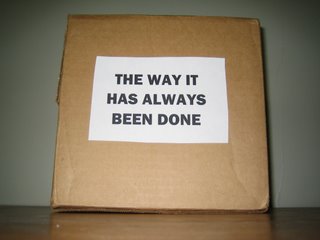
The next Disability Blog Carnival will be hosted by Goldfish on Thursday, November 23. The theme for this carnival is "Different ways of going about things." I think this is a great theme, because we with disabilities learn something that everyone should know: you don't have to do something the way it's always been done.

I completed high school in six years. I studied two to four classes at a time making use of a variety of formats. Some classes, such as World History, English and Biology, I physically took at the school. Two afternoons a week, a tutor came to my house for one-on-one Spanish classes, allowing me to stretch out on the carpet and rest my body. Over the summers and during other “slow” times, my mom and I independently progressed through algebra and geometry. I completed lighter classes like health and consumer economics through correspondence courses. I took one semester of physics and one semester of chemistry online.

Why did I do things this way? How did this decision come about?

Through 14 years of raising triplets, each of us a unique individual, my parents had already learned to look at my needs and my goals as the first step in making this type of decision. We had already done elementary and junior high school in unique ways, so making careful decisions was nothing new to us.

Some goals for my high school years were: prepare for college by taking strong academic courses; continue with my singing and other hobbies, while exploring new interests; spend time with friends; strengthen my body with daily exercise; and let my body have the daily rest that it needs.

Our decision (actually, mainly my parents' decision in the early years) gave me the opportunity for success. I believe I am well prepared for college. Taking fewer classes at one time and spreading them over a longer number of years, allowed me to take some honors classes, including a philosophy class and Advanced Placement Spanish. I was able to complete math requirements, my most challenging subject area due to visual and conceptual difficulties, at my own pace and in a highly personalized way adapted to fit my learning style. An advantage of the online science classes was the opportunity to work in an interactive virtual lab. In the virtual lab, I got to weigh samples, fill test tubes, light a burner, and perform other tasks I am not physically able to do. (Unfortunately, the online chemistry class was highly disorganized and filled with errors, but that's another story.)

I continued my singing throughout high school. I really enjoyed taking voice lessons and singing at both my church and school. I sang in a few school musicals, but sadly and frustratingly, the school had difficulty accommodating my wheelchair, so I did not pursue this interest as much as I would have liked.

During high school, I had some fun times with friends, although like most students, I would have liked to have spent more time with them. The last two years were more challenging socially since my peers had already graduated.

When I would leave school after a partial day, both students and staff would frequently comment, "Oh, David! You're so lucky you get to go home." Little did they know, it was often difficult and painful for me to sit in my wheelchair for half a day, and I was going home to rest, recover, and do physical therapy exercises to strengthen my body.

My path through high school was an unconventional one. I still believe in my goals, but that didn't make life easy. I was juggling challenging academics, physical needs, hobbies, and a social life, while the obstacles of an inaccessible world, some people’s unsupportive attitudes, my pain, and my limited stamina often worked to sabotage my juggling act. At times, life was very stressful, and my time was always a precious resource.

My most difficult sacrifice was not graduating high school in four years with my peers. It was really tough watching my friends, many I had known for 12 years, start a new phase of their lives, all the while knowing that I would be returning to high school. So I wonder - was there any way that I could have met my goals while graduating in four years? I know I couldn't have taken a heavier academic load, and to cut my non-school interests, my social life, or my rest any further would have been unacceptable. So, I'm left wondering about the pull between my work on my body, which I did for several hours a day, versus graduating in four years. I don't know the answer to this question. Physical therapy has certainly improved my strength, stamina, and capabilities, and it has definitely reduced my pain. However, those benefits have come at a cost: the loss of time to meet my other goals and still graduate from high school in four years.

I am grateful to my parents for thinking “outside the box” and for teaching me how to make decisions. My parents have shown me some steps in how to make a decision: identify my values, priorities, and goals, then think of possible ways to make the goals happen. There are many tools in the toolbox to help make goals happen - brainstorming, seeing what others in a similar situation have done, and listening to what "experts" advise. It seems to me that in our society, many decisions are made for people with disabilities by simply doing what has always been done. Each of us needs to think for ourselves about our own individual goals, and then use our toolbox of tools to make the best decisions.